
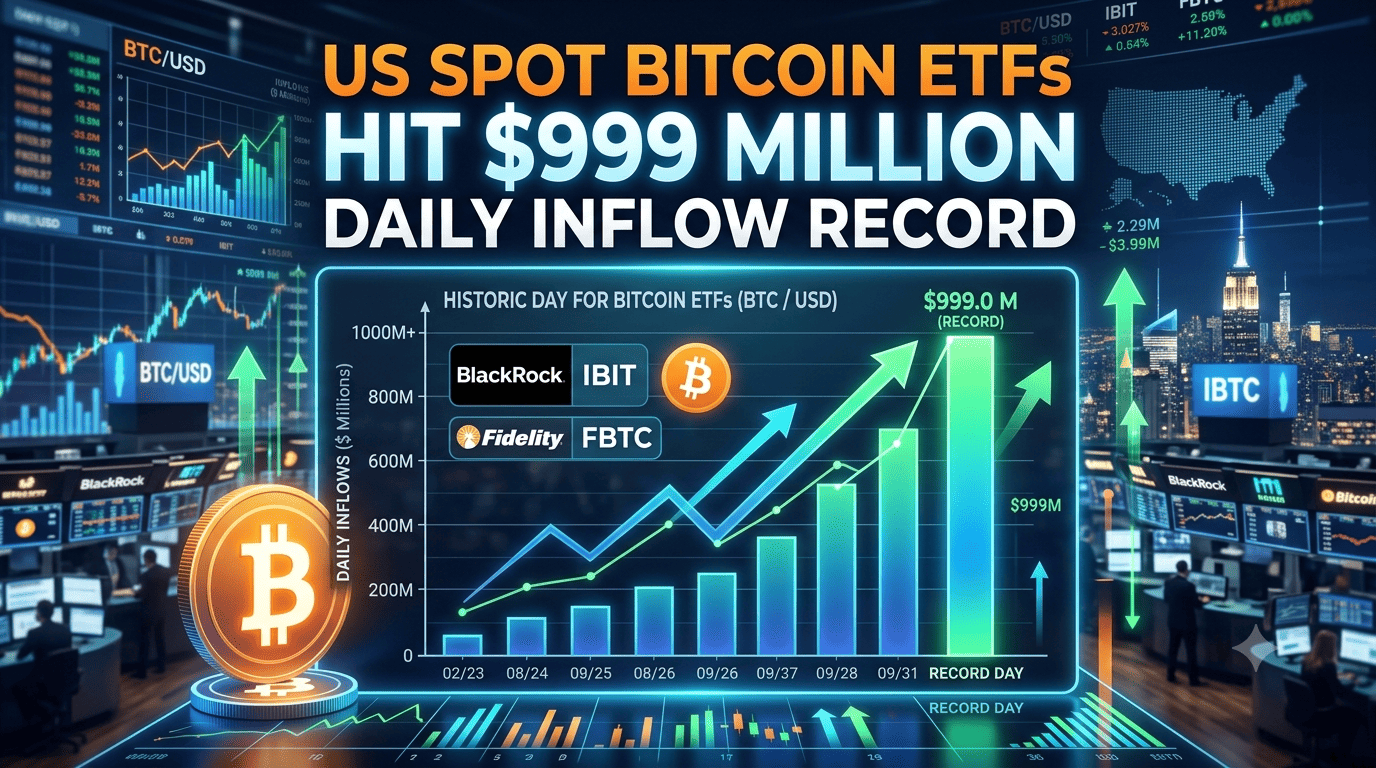
The United States market for spot Bitcoin exchange-traded funds (ETFs) experienced its most significant day of the year on September 21, 2026. According to market data, these investment vehicles recorded a collective net inflow of $999 million during the single-day session. This surge in capital allocation coincided with a notable upward movement in the underlying asset’s price, which cleared the $86,000 threshold and briefly touched levels exceeding $87,000.
The scale of the day’s activity was further evidenced by the physical amount of Bitcoin acquired by the funds. Collectively, the ETFs absorbed approximately 11,530 BTC. This level of acquisition represents one of the most substantial one-day net intakes in the history of the product class, highlighting a period of intense demand from market participants utilizing regulated brokerage accounts.
Key Developments in the ETF Sector
- US spot Bitcoin ETFs recorded $999 million in net inflows on September 21, 2026, marking the highest daily total for the current year.
- The funds collectively acquired 11,530 BTC as the market price of Bitcoin surpassed $86,000.
- BlackRock’s iShares Bitcoin Trust (IBIT) remained the primary driver of growth, contributing $381.4 million to the daily total.
- Total secondary-market trading volume for the session reached approximately $4.5 billion, suggesting high liquidity and active participation.
A Landmark Day for Institutional Bitcoin Products
The $999 million inflow recorded on September 21 stands as a pivotal moment for the cryptocurrency investment landscape in 2026. This figure represents the largest daily total since October 6, 2025, when the funds attracted a record-setting $1.2 billion. The recent influx of capital suggests a renewed appetite for Bitcoin exposure through traditional financial structures, following a period earlier in the year characterized by more cautious market behavior and intermittent outflows.
The price action during the session provided a backdrop for the aggressive buying. As Bitcoin’s valuation climbed past $86,000, reaching its highest point since January, the demand for ETF shares appeared to accelerate. The brief excursion above $87,000 likely contributed to the heightened trading activity seen across the various fund offerings. This correlation between price appreciation and fund inflows often points to a momentum-driven environment where participants seek to establish or expand positions during breakout phases.
Furthermore, the absorption of 11,530 BTC in a single day is a metric that market analysts track closely. This figure represents the largest one-day net intake since November 11, 2024, when 12,560 BTC were added to the funds. Such large-scale removals of Bitcoin from the liquid market into the custody of ETF providers can have implications for the available supply on exchanges, though the long-term impact on market stability remains a subject of ongoing observation.
Concentration of Capital Among Leading Issuers
While the total inflow was spread across several products, the majority of the capital was concentrated in the top three performing funds. BlackRock’s iShares Bitcoin Trust (IBIT) continued its trend of dominance, securing $381.4 million in new capital. This fund has consistently led the pack in terms of assets under management and daily liquidity, making it a primary destination for both retail and institutional investors.
Following BlackRock, the ARK 21Shares Bitcoin ETF (ARKB) reported a substantial $289.1 million in net inflows. Fidelity’s Wise Origin Bitcoin Fund (FBTC) also saw significant activity, bringing in $238.8 million. Together, these three funds accounted for more than $909 million of the $999 million total, representing over 90% of the day’s net inflows. This concentration highlights the competitive landscape of the ETF market, where a small number of established issuers capture the vast majority of investor interest.
The remaining funds in the category contributed the balance of the inflows, though their individual totals were modest in comparison to the leaders. The disparity between the top-tier funds and the rest of the field underscores the importance of brand recognition, fee structures, and liquidity in the eyes of market participants. As the sector matures, the gap between the largest funds and smaller competitors appears to be maintaining its breadth.
Volume and Investor Sentiment Analysis
Beyond the net inflow figures, the secondary-market trading volume provided additional insight into the day’s market dynamics. Approximately $4.5 billion worth of ETF shares changed hands during the session. High trading volume typically indicates a healthy level of liquidity, allowing large participants to enter and exit positions without causing excessive price slippage within the ETF shares themselves.
Bloomberg Intelligence analyst Eric Balchunas provided context on the nature of these inflows. He observed that the pattern of activity appeared somewhat irregular, suggesting that the $999 million total was likely the result of dispersed investor activity rather than a single, massive allocation from a lone institution or sovereign entity. This interpretation implies a broad-based participation across various segments of the market, which may be viewed as a sign of wider adoption rather than reliance on a few large “whales.”
The analyst’s perspective also touches on the mechanics of how these funds operate. Reported fund flows often reflect the creation and redemption activity from previous trading days due to standard reporting lags. In this instance, the figures reported for Monday, September 21, likely encompass some of the trading and creation activity that occurred during the previous Friday. This lag is a standard feature of the ETF reporting cycle and is factored into the analysis of daily volatility and capital movement.
Historical Significance and Market Context
The recent surge in inflows represents a notable reversal from the market-weighing outflows that were recorded earlier in 2026. During the first half of the year, the ETF sector faced headwinds as investors navigated shifting macroeconomic conditions and periods of price consolidation. The return to near-billion-dollar daily inflows suggests a shift in sentiment, potentially driven by the asset’s return to price levels not seen since the start of the year.
Comparing the current data to historical milestones provides a sense of the market’s trajectory. The 11,530 BTC intake, while significant, remains slightly below the peak seen in late 2024. However, the dollar value of these inflows is bolstered by the significantly higher price of Bitcoin in late 2026 compared to previous years. This means that while the number of coins being moved into ETFs is comparable to past peaks, the total capital being deployed into the ecosystem is reaching new heights in nominal terms.
The role of institutional-grade custody and the ease of access provided by the ETF wrapper continue to be cited as primary factors for these large-scale movements. By allowing investors to gain exposure to Bitcoin price movements through traditional brokerage accounts, these products have effectively bridged the gap between the digital asset market and conventional finance.
What Happens Next
As the market processes this record-breaking day, attention will turn to whether this level of demand can be sustained. The reporting of these figures often leads to increased market visibility, which can influence subsequent trading sessions. Observers will be watching to see if the $999 million inflow marks the beginning of a sustained trend or if it represents a localized peak in investor enthusiasm.
The relationship between the ETF inflows and the spot price of Bitcoin will also remain a focal point. If the funds continue to absorb thousands of BTC daily, the impact on exchange liquidity and price discovery will be closely monitored by analysts. Additionally, the upcoming reporting cycles will clarify whether the “dispersed activity” noted by analysts continues to characterize the market or if larger, more concentrated institutional allocations begin to emerge.
Finally, the performance of the smaller ETFs in the category will be under scrutiny. With the top three funds dominating the vast majority of inflows, the long-term viability of smaller issuers may depend on their ability to differentiate their offerings or capitalize on niche segments of the market. For now, the focus remains on the primary drivers of the sector as they navigate a period of historic capital movement.