
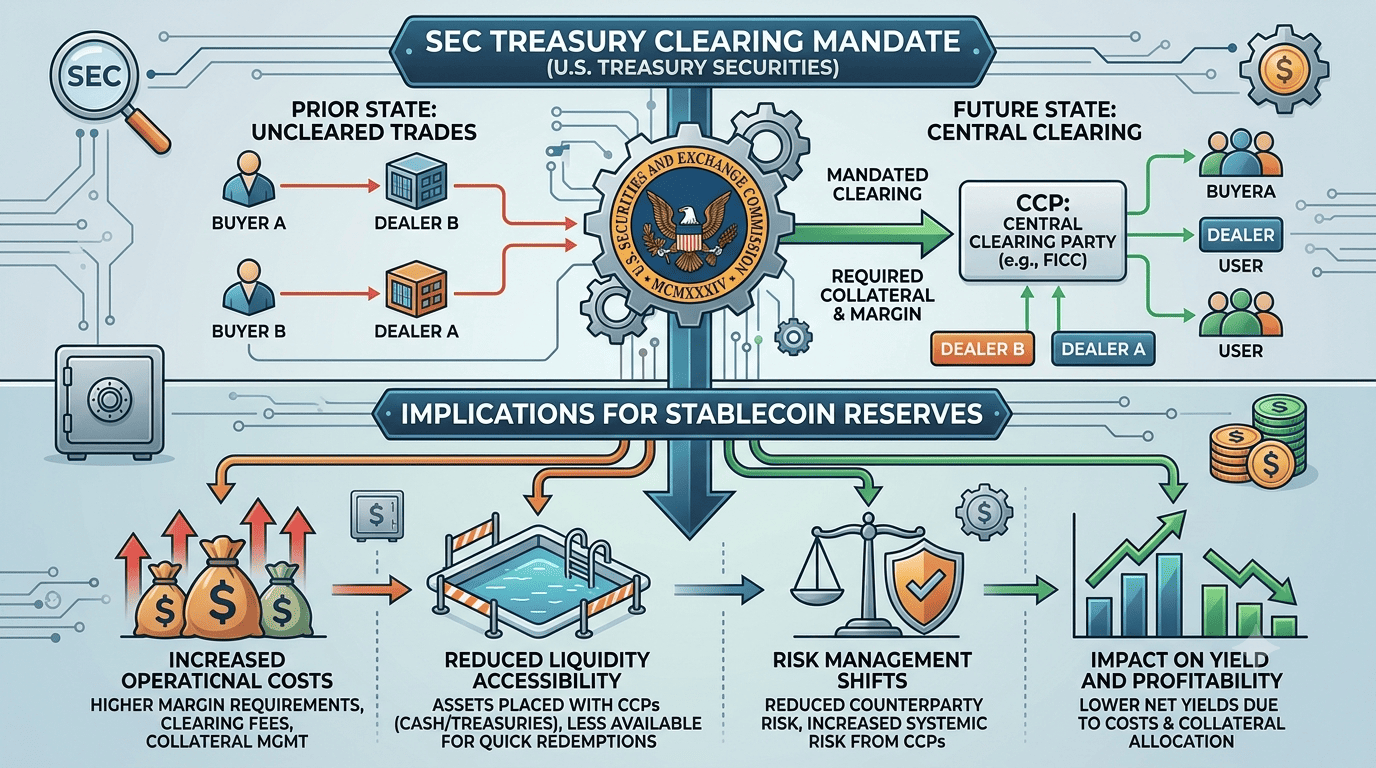
The Securities and Exchange Commission (SEC) is moving forward with a significant regulatory overhaul of the U.S. Treasury market, introducing rules that require a broader range of transactions to be processed through central clearinghouses. While these changes are primarily aimed at the traditional financial sector, the implications are expected to resonate deeply within the cryptocurrency industry, particularly for stablecoin issuers who rely on Treasury securities to back their digital assets.
By shifting more of the $27 trillion Treasury market toward a centralized model, the SEC aims to enhance market stability and reduce systemic risk. However, for the digital asset ecosystem, this transition introduces new operational complexities. Stablecoin providers, who function as a bridge between blockchain technology and traditional finance, must now navigate a changing landscape for the very assets that provide their tokens with value and liquidity.
Key Developments in Treasury Market Regulation
- The SEC is implementing a mandate that requires a larger portion of U.S. Treasury trades, including outright purchases and repurchase agreements (repos), to pass through a central clearinghouse.
- Central clearing utilizes a process known as “netting,” which recognizes offsetting positions to potentially lower the amount of capital and balance-sheet space required by dealers.
- Participants in the clearinghouse system are required to post margin, consisting of cash or eligible securities, to serve as collateral against potential defaults.
- A recent industry survey indicates a gap in readiness, with only about one-third of surveyed clearing members expecting to offer Treasury cash clearing services to their clients despite having the necessary account structures.
The Intersection of Stablecoins and Treasury Markets
The connection between the U.S. Treasury market and the cryptocurrency sector has grown substantially over the last several years. Major stablecoin issuers now rank among the significant holders of U.S. government debt, using these low-risk securities as the primary reserve backing for their tokens. This relationship ensures that for every digital dollar in circulation, there is a corresponding high-quality asset held in reserve.
The utility of Treasuries for stablecoin issuers extends beyond mere holding. These entities frequently rely on the secondary market and the repurchase agreement (repo) market to maintain liquidity. In a repo transaction, an institution sells a security with an agreement to buy it back later, effectively using the Treasury as collateral for a short-term cash loan. This mechanism is vital for stablecoin issuers who must quickly convert their reserves into cash to satisfy customer redemptions, especially during periods of high market volatility.
As the SEC mandates central clearing for these transactions, the process of converting Treasuries to cash may become more structured. While central clearing is designed to make the market more robust, it also requires participants to adhere to strict margin requirements. For stablecoin issuers, this means a portion of their liquidity must be dedicated to collateralizing their positions within the clearinghouse, potentially altering the efficiency of their redemption pipelines.
Capital Efficiency and the Role of Netting
One of the primary arguments in favor of the SEC’s new rules is the potential for increased capital efficiency through netting. In the current bilateral market, many trades are settled individually, which can tie up significant amounts of capital for banks and securities firms acting as intermediaries. Central clearinghouses, such as the Fixed Income Clearing Corporation (FICC), allow for the netting of buy and sell orders across multiple parties.
According to the SEC, this netting process can reduce the overall balance-sheet resources that dealers need to commit to the market. By lowering the capital burden on intermediaries, the rules could theoretically increase the capacity of the market to handle large volumes of trades. This is particularly relevant given the explosive growth of the Treasury market; data from the New York Fed indicates that activity used to calculate the Secured Overnight Financing Rate (SOFR) rose from approximately $1 trillion in early 2022 to nearly $3 trillion in recent months.
However, SEC Commissioner Mark Uyeda and other observers have noted that while netting offers benefits, the requirement to post margin introduces a different kind of liquidity demand. Market participants must have ready access to cash or eligible securities to meet margin calls, which could create friction during times of market stress if many participants are forced to post additional collateral simultaneously.
Industry Readiness and Access Challenges
Despite the looming deadlines for these regulatory changes, the industry appears to be in a state of partial readiness. A July survey conducted by the Depository Trust & Clearing Corporation (DTCC) revealed a disparity between technical setup and service availability. While 79% of FICC netting members reported having the necessary account structures in place, only about 33% of those surveyed expected to offer Treasury cash clearing services to their external clients.
This gap suggests that many smaller participants, including some stablecoin issuers or their specialized financial partners, may face challenges in accessing the cleared market. If only a limited number of dealers are willing to provide clearing services to clients, the cost of transacting in the Treasury market could rise, or the availability of liquidity could become concentrated among a few large players.
The transition also highlights the persistent gap between the 24/7 nature of cryptocurrency markets and the traditional operating hours of the U.S. banking and securities infrastructure. Stablecoin transfers occur at all hours, but the liquidation of Treasury reserves remains tethered to the schedules of clearinghouses and traditional financial intermediaries. The new SEC rules add another layer of institutional process to this bridge, potentially complicating the real-time management of digital asset reserves.
What Happens Next
The implementation of these rules will follow a phased timeline, giving market participants a window to adjust their operations. The first major milestone arrives on December 31, which serves as the deadline for eligible outright Treasury purchases and sales to enter the central clearing system. This will be the first major test of the new infrastructure’s ability to handle the increased volume of cleared trades.
The second phase of the mandate focuses on the repo market, with a deadline set for June 30, 2027. This longer lead time reflects the complexity of the repo market and its critical role in providing short-term funding for the broader financial system. For stablecoin issuers, this period will be crucial for establishing the necessary relationships with clearing members or exploring direct participation models where available.
As these deadlines approach, the industry will be watching for signs of how the clearing mandate affects market liquidity and the cost of maintaining stablecoin reserves. The SEC’s move represents a fundamental shift in how the world’s most important bond market operates, and its success will depend on whether the benefits of reduced systemic risk outweigh the operational hurdles and capital requirements imposed on market participants.