
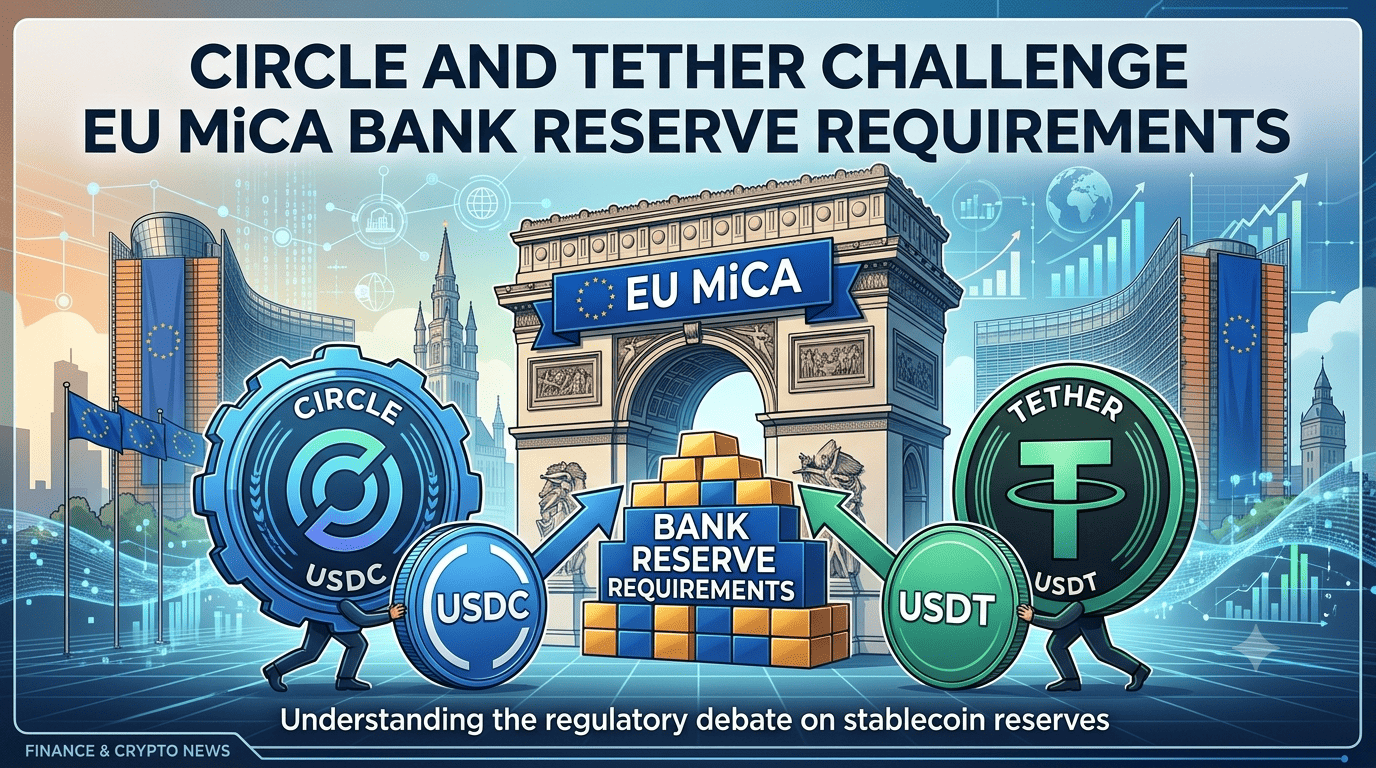
The European Union’s Markets in Crypto-Assets (MiCA) regulation, designed to provide a comprehensive legal framework for digital assets, is facing significant pushback from the world’s leading stablecoin issuers. Circle and Tether, the entities behind the most prominent dollar-pegged tokens, have expressed formal opposition to specific provisions regarding bank reserve requirements. These objections center on the mandate for issuers to hold a substantial portion of their backing assets in commercial bank deposits.
While MiCA is often praised for bringing clarity to the burgeoning crypto sector, the practicalities of its reserve management rules have sparked a debate over systemic risk. Issuers argue that the current requirements could inadvertently introduce the very financial instability the regulation seeks to prevent. As the European Commission concludes its review of these policies, the tension between regulatory oversight and the operational realities of global stablecoins has become a focal point for the industry.
Key Points of the MiCA Reserve Dispute
- Circle and Tether oppose MiCA rules requiring stablecoin issuers to keep 30% to 60% of reserves in commercial bank deposits.
- Circle has proposed a “recognition regime” to allow foreign-regulated tokens to circulate in the EU under equivalent standards.
- Tether has declined to seek an EU license, citing the bank reserve mandates as a primary deterrent to compliance.
- The European Banking Authority (EBA) remains concerned that alternative issuance structures could move critical functions beyond its supervisory reach.
The Conflict Over Bank Reserve Mandates
At the heart of the disagreement is the MiCA requirement for e-money token (EMT) issuers. Under the current framework, issuers must maintain at least 30% of their reserves in commercial bank deposits. For tokens classified as “significant” due to their scale and market impact, this requirement increases to 60%. The regulation aims to ensure that stablecoins are backed by liquid assets that can be easily accessed during periods of high redemption demand.
However, Circle and Tether contend that concentrating such large volumes of capital in commercial banks creates unnecessary counterparty risk. They argue that sovereign debt, such as government bonds, is a more stable and secure form of backing. By forcing issuers to rely on the commercial banking sector, the regulation potentially exposes stablecoin holders to the credit risks of individual lending institutions.
Furthermore, Circle has requested the removal of specific caps that limit flexibility in reserve management. This includes a 35% cap on exposure to any single sovereign entity and a rule that limits deposits with an individual bank to just 1.5% of that lender’s total assets. According to industry advocates, these granular restrictions make it difficult for large-scale issuers to find enough banking partners capable of holding the required billions of dollars in deposits without breaching regulatory thresholds.
Circle Proposes Alternative Regulatory Pathways
Circle, which has otherwise sought to align itself with MiCA standards for its USDC and EURC tokens, is advocating for structural changes to how the EU handles foreign entities. One of the primary suggestions is the establishment of a “recognition regime.” This system would allow stablecoin issuers regulated in foreign jurisdictions to distribute their tokens within the European Union without undergoing the full EU authorization process, provided their home country’s standards are deemed equivalent to MiCA.
In addition to the recognition regime, Circle is pushing for the preservation of “multi-issuance” structures. This model involves a MiCA-authorized entity co-issuing a stablecoin alongside a foreign-regulated counterpart. Circle suggests that this approach would allow for global liquidity while maintaining a footprint within the European regulatory environment. By utilizing multi-issuance, the company believes it can bridge the gap between different jurisdictional requirements without fragmenting the market.
The proposal aims to address the global nature of digital assets. Since stablecoins often operate across borders simultaneously, Circle argues that a rigid, EU-centric issuance model could isolate the European market from global liquidity pools. The company maintains that equivalence-based recognition would provide a more pragmatic path forward for international financial stability.
Tether’s Strategic Withdrawal from EU Licensing
While Circle is attempting to negotiate amendments to the framework, Tether has taken a more definitive stance. Tether CEO Paolo Ardoino recently confirmed that the company has declined to seek a license under the MiCA framework specifically because of the bank reserve requirements. Tether, the issuer of USDT, the world’s largest stablecoin by market capitalization, has long prioritized holding the majority of its reserves in U.S. Treasuries and other highly liquid instruments.
Ardoino’s statements highlight a fundamental philosophical divide between the EU regulators and some of the industry’s largest players. From Tether’s perspective, the requirement to place a majority of reserves in commercial banks is not only a business hurdle but a risk to the stability of the token itself. The company has expressed concerns that bank failures could lead to a loss of reserve funds, a scenario they believe is less likely when holding direct sovereign debt.
This decision leaves Tether in a unique position within the European market. Without a MiCA license, the availability of USDT on regulated European exchanges may face restrictions. This development underscores the potential for a bifurcated market where some issuers choose to comply with the EU’s strict mandates while others remain outside the perimeter, focusing on global markets with different reserve philosophies.
Systemic Risk and the Regulatory Response
The European Banking Authority (EBA) has not been silent regarding the proposals put forth by industry leaders. The EBA has expressed significant reservations about multi-issuer structures and recognition regimes. The primary concern for the authority is the potential for “regulatory arbitrage,” where companies might use offshore entities to bypass EU consumer protection and prudential standards.
Regulators fear that if critical functions—such as the management of reserves or the issuance of tokens—are moved to jurisdictions outside the EU’s direct supervision, it could create blind spots. In the event of a financial crisis or a stablecoin de-pegging event, the EBA argues it would have limited tools to intervene if the core operations are not fully contained within the MiCA framework. This tension reflects the broader challenge of regulating a decentralized and global technology within traditional geographic borders.
The European Commission’s consultation on the MiCA review concluded on September 30. This period allowed stakeholders to submit evidence and arguments regarding the impact of the current rules. The feedback received during this window will be instrumental in determining whether the Commission decides to propose amendments to the reserve requirements or maintain the current strict thresholds for bank deposits.
What Happens Next
The conclusion of the consultation period marks the beginning of a deliberative phase for European regulators. The European Commission will now analyze the submissions from Circle, Tether, and other financial institutions to assess whether the 30% and 60% bank reserve mandates pose a genuine systemic risk or if they are necessary for consumer protection. There is no confirmed timeline for when a final decision or potential legislative amendment might be announced.
In the coming months, the industry will be watching for any signs of flexibility regarding the “recognition regime” or the 1.5% bank deposit cap. If the EU maintains its current stance, it could lead to a significant shift in the European crypto landscape, potentially limiting the variety of stablecoins available to EU residents. Conversely, if the Commission adopts Circle’s proposals, it could set a precedent for how other major economies handle the cross-border regulation of digital assets.
For now, the status of major stablecoins in Europe remains in a state of transition. Issuers must decide whether to adapt their reserve strategies to meet MiCA’s stringent demands or risk losing access to one of the world’s largest economic blocs. The outcome of this regulatory tug-of-war will likely influence stablecoin policy far beyond the borders of the European Union.