
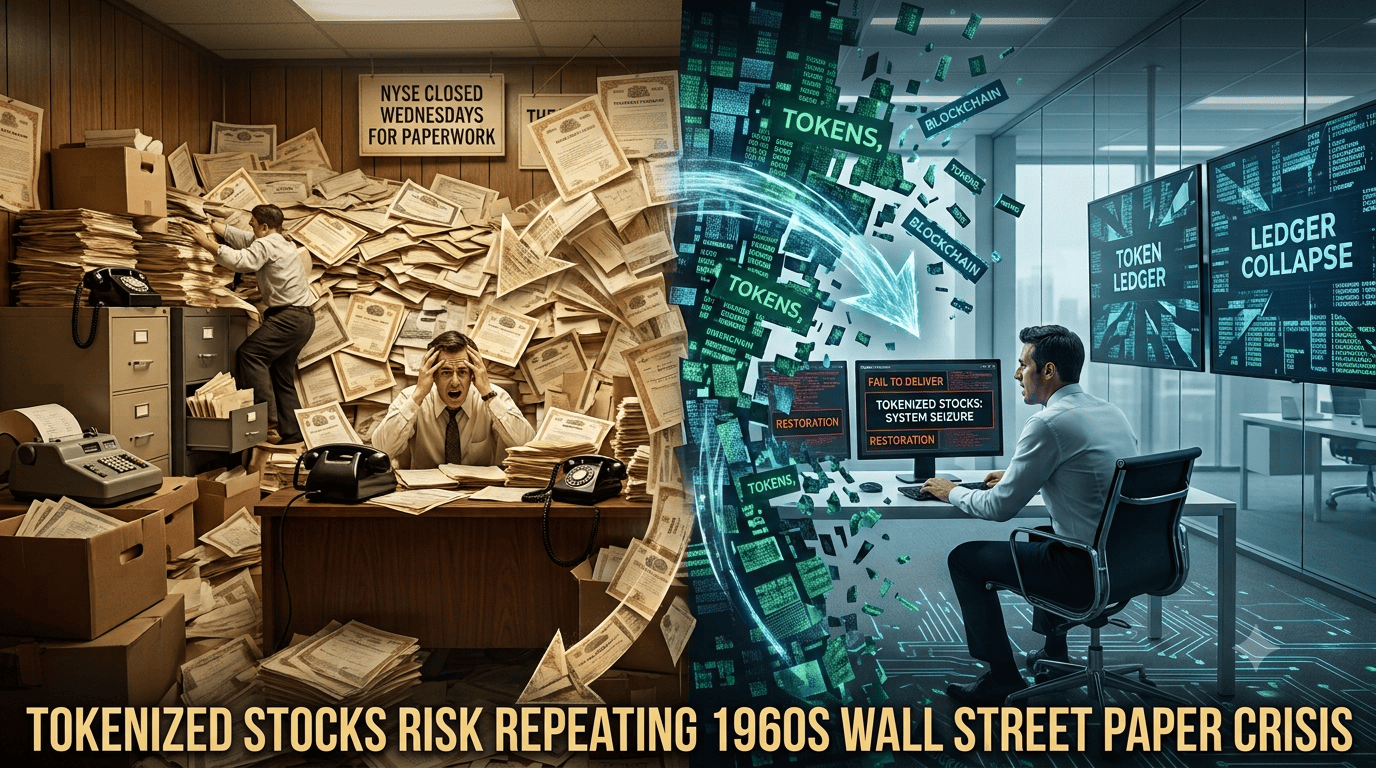
Tokenized stocks risk recreating the operational failures of the 1960s Wall Street “paper crisis” if the digital asset industry continues to build on fragmented, non-standardized systems. Fairmint CEO Joris Delanoue warned that the current trajectory of Real World Asset (RWA) tokenization could lead to a systemic settlement bottleneck, according to recent industry commentary.
Key Points:
- 12 million shares per day overwhelmed Wall Street’s manual processing capacity during the 1960s crisis.
- Fragmentation across proprietary blockchains creates siloed liquidity pools.
- Standardized interoperability is required to prevent digital settlement failures.
The warning from the Fairmint executive comes as institutional interest in tokenization reaches a fever pitch. While the promise of blockchain technology is to provide instantaneous, 24/7 settlement, the reality of the current landscape is a patchwork of competing protocols and private ledgers. Delanoue argues that this lack of cohesion mirrors the mid-century period when the New York Stock Exchange was forced to shorten its trading week because it could not keep up with the physical paperwork required to finalize trades.
During the 1960s, a sudden surge in trading volume caught brokerage firms unprepared, leading to a massive backlog of uncertified stock certificates. This period, known as the “Paperwork Crisis,” eventually forced Wall Street to shut down every Wednesday to allow back-office staff to catch up. Delanoue suggests that unless the crypto industry adopts unified standards, the modern equivalent—a digital settlement logjam—is inevitable. The risk is that the ledger itself becomes a liability rather than an efficiency tool.
Tokenized Stocks Risk Fragmentation

The primary concern expressed by Delanoue is the proliferation of siloed blockchain environments. Currently, major financial institutions are experimenting with a wide array of networks, ranging from public chains like Ethereum and Avalanche to permissioned, private ledgers. This “walled garden” approach prevents the seamless transfer of value between different platforms, effectively recreating the friction that tokenization was intended to solve. If a tokenized stock on one chain cannot be easily traded for a stablecoin on another, the efficiency gains of the technology are largely neutralized.
According to Delanoue, the industry is currently building “digital islands.” For tokenized stocks to scale effectively, there must be a common communication layer that allows these assets to move across different infrastructures without human intervention or complex intermediary layers. Without this, the industry risks a scenario where the speed of trade execution far outstrips the speed of actual settlement, leading to systemic instability similar to the manual errors of the 1960s.
Lessons From 1960s Paperwork

To understand the current danger, one must look at the historical precedent. In 1968, the paperwork crisis became so severe that it threatened the solvency of major brokerage houses. The issue was not the volume of trades itself, but the inability of the existing infrastructure to verify and record those trades in a timely manner. Today, the RWA tokenization market faces a similar challenge: the technical infrastructure is being built in fragments that do not always communicate with one another.
The historical crisis was eventually solved through the creation of the Depository Trust Company (DTC) and the move toward book-entry settlement. Delanoue argues that the crypto industry is currently in the “pre-DTC” phase, where every participant is attempting to build their own proprietary clearing system. While competition drives innovation, the absence of a shared source of truth or a universal standard for digital securities could lead to a breakdown in trust if a high-volume event occurs.
Industry data suggests that the tokenized asset market could reach a multi-trillion dollar valuation by 2030. However, this growth is contingent upon the ability of various blockchains to achieve interoperability. Financial giants such as BlackRock and Franklin Templeton have already launched tokenized funds, but these operate within specific ecosystems. If these assets remain trapped within their respective networks, the market liquidity remains fractured, increasing the risk of price volatility and settlement delays during periods of high stress.
Looking forward, the success of tokenized securities will likely depend on the adoption of cross-chain communication protocols and regulatory frameworks that mandate technical standards. Regulatory bodies in the United States and Europe have begun to signal a preference for standardized reporting and settlement, but the technical implementation remains in the hands of private developers. As the industry matures, the focus must shift from merely putting assets on-chain to ensuring those assets can move freely across the global financial ecosystem without repeating the structural failures of the past.