
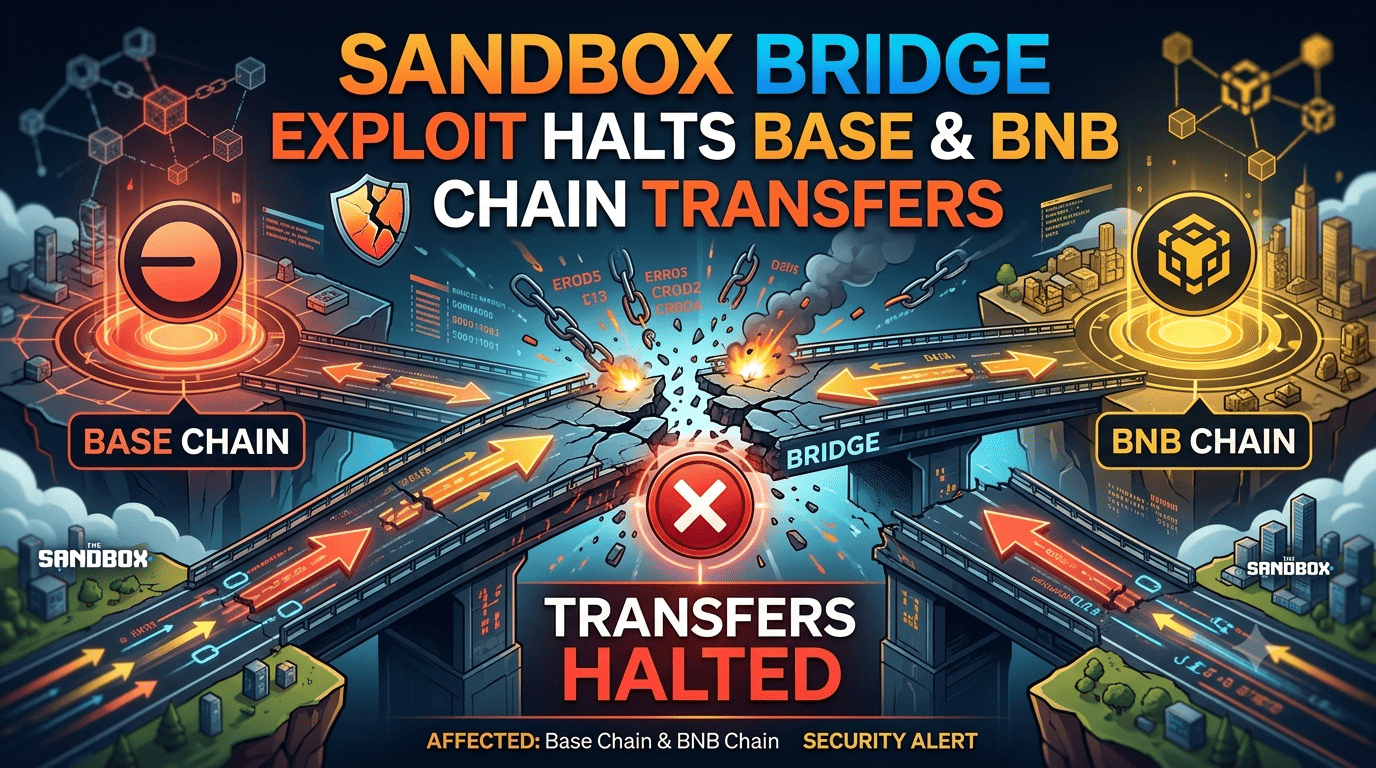
The Sandbox (SAND) suspended token bridging services on the Base and BNB Chain networks on Friday following the discovery of a **Sandbox bridge exploit**. The Web3 gaming platform took the action to isolate affected assets, noting that the breach impacted less than 0.01% of the total SAND token supply.
Key Points:
- Less than 0.01% of the total SAND supply was affected by the exploit.
- The Sandbox disabled all bridging functions on Base and BNB Chain networks.
- Platform developers issued an urgent warning against trading SAND on affected chains.
- Security teams are currently working to isolate and secure compromised tokens.
The Sandbox, a prominent player in the decentralized metaverse space, confirmed the security incident through its official communication channels. The primary objective of the suspension is to prevent further unauthorized movement of assets while the technical team conducts a comprehensive forensic audit. By disabling the bridging contracts between Ethereum, Base, and BNB Chain, the project aims to contain the vulnerability and protect the broader ecosystem from potential contagion.
According to reports from the platform’s security monitoring systems, the incident was localized to specific cross-chain pathways. The Sandbox team emphasized that the vast majority of user funds remain secure, as the breach targeted a very narrow segment of the liquidity pool. Despite the limited scope of the loss, the protocol has advised all users to exercise extreme caution and refrain from purchasing or selling SAND tokens on the Base and BNB Chain decentralized exchanges until further notice.
Bridging services suspended immediately
The decision to halt bridging services came after unusual activity was detected within the smart contracts governing the transfer of tokens between disparate blockchain layers. Cross-chain bridges are frequently targeted by malicious actors because they hold large amounts of locked collateral to facilitate the minting of “wrapped” assets on secondary chains. The Sandbox bridge exploit appears to have leveraged a specific weakness in how these transactions were validated on the Base and BNB Chain integrations.
Technical experts at the platform are currently investigating the entry point of the exploit. Initial assessments suggest that the attacker was able to manipulate the bridge’s minting logic, though the platform has not yet released a full technical post-mortem. To facilitate transparency, The Sandbox official website has provided real-time updates to its community, ensuring that holders of the SAND token are aware of the operational status of the network.
Base, the Ethereum Layer 2 incubated by Coinbase, and BNB Chain, the ecosystem supported by Binance, have both seen significant growth in Web3 gaming activity recently. However, this growth has also made them high-value targets for bridge exploits. The Sandbox had recently expanded its footprint to these chains to offer users lower transaction fees and faster confirmation times, a move that is now under scrutiny following this security setback.
Token supply impact localized
Quantifying the damage, the project lead confirmed that the impact was restricted to less than 0.01% of the circulating supply. For a token with a multi-billion dollar fully diluted valuation, this percentage represents a manageable sum in terms of market liquidity, yet it highlights the persistent risks inherent in multi-chain interoperability. The Sandbox bridge exploit serves as a reminder that even established protocols with high TVL (Total Value Locked) are susceptible to sophisticated smart contract vulnerabilities.
The price of the SAND token showed localized volatility following the announcement, particularly on decentralized exchanges (DEXs) within the Base and BNB Chain ecosystems. Arbitrageurs often look for price discrepancies during such events, but the platform’s warning against trading is intended to prevent users from interacting with potentially “tainted” or unbacked tokens that may have been generated during the exploit. Centralized exchanges have largely remained unaffected, as the primary SAND liquidity remains on the Ethereum mainnet and the Polygon network.
Historical data shows that bridge exploits have been one of the most significant drainers of value in the DeFi and NFT sectors over the past three years. Notable incidents involving the Ronin Network and the Nomad Bridge resulted in losses totaling hundreds of millions of dollars. In comparison, the Sandbox bridge exploit appears significantly smaller in scale, suggesting that the platform’s early detection systems and rapid response protocols were effective in limiting the attacker’s reach.
Protocol security measures implemented
In response to the breach, The Sandbox has initiated a series of security upgrades to its cross-chain infrastructure. The team is collaborating with external security firms to audit the code of the affected bridges before they are reopened to the public. These measures include more rigorous multi-signature requirements for large withdrawals and enhanced monitoring for abnormal minting patterns that could indicate a recurring vulnerability.
The broader Web3 gaming industry continues to grapple with the trade-off between user experience and security. While bridging tokens to Layer 2 and alternative Layer 1 networks is essential for scaling, it introduces additional layers of risk. The Sandbox has reiterated its commitment to decentralized governance and security, promising a detailed report once the investigation is finalized and the bridge is deemed safe for redeployment.
Looking ahead, the recovery of the bridged SAND ecosystem will depend on the platform’s ability to restore user confidence and ensure that the isolated tokens do not impact the broader market. Market analysts expect the bridge to remain offline for several days as the developers implement patches. This event is likely to fuel further discussions regarding the necessity of standardized security protocols for cross-chain communication in the burgeoning metaverse sector.