
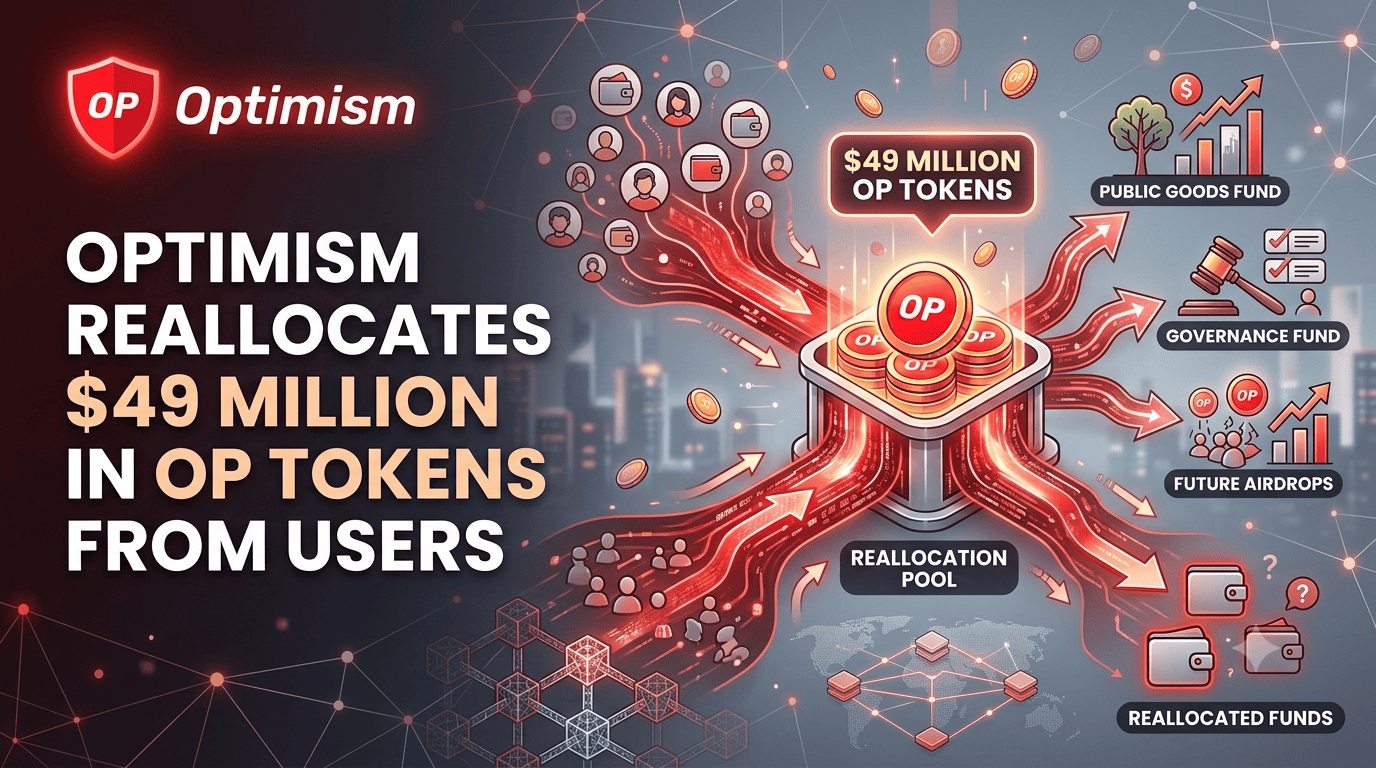
Optimism governance has finalized a controversial proposal to reallocate 546.9 million **Optimism OP tokens** from the designated user airdrop pool to a new Foundation-controlled fund. The decision, which shifts approximately $49 million in market value, was secured by a narrow margin following a deciding vote from an entity currently funded by the Optimism Collective.
Key Points:
- 546.9 million OP tokens were moved from airdrop reserves to an ecosystem fund.
- An Optimism-funded team provided the critical deciding vote for the measure.
- The reallocation represents roughly $49 million in current market value.
The approved plan effectively transfers a massive portion of the “User Airdrops” allocation—originally intended for direct distribution to network participants—into the Strategic Ecosystem Fund. According to the proposal documentation, the Optimism Foundation will now manage these assets to support long-term scaling initiatives and developer grants. The shift marks a significant pivot in how the Layer 2 network manages its treasury, moving away from broad community distributions in favor of targeted institutional spending.
The governance process has come under scrutiny from community members and market analysts due to the nature of the final tally. Data from the governance portal indicates that the deciding vote was cast by a team that receives operational funding from the Optimism Collective, creating what some critics describe as a “circular governance” loop. This internal support was necessary to overcome significant opposition from independent token holders who argued that the reallocation dilutes the value proposition for early adopters and daily users of the network.
Shifting Optimism OP Tokens
The reallocation of **Optimism OP tokens** reflects a broader trend among Layer 2 solutions to prioritize ecosystem sustainability over short-term user incentives. By moving 546.9 million tokens into the Strategic Ecosystem Fund, the Foundation gains the ability to deploy capital more aggressively toward partnerships and infrastructure projects. Proponents of the move argue that large-scale airdrops often result in immediate sell pressure, whereas a managed fund can facilitate more controlled and strategic growth.
However, the move has raised questions regarding the original promises made during the project’s inception. The user airdrop pool was a cornerstone of Optimism’s marketing, designed to reward the “Superchain” community for its participation. Governance records show that while the Foundation maintains this is a “refinement” of the tokenomics model, the reduction in available airdrop supply could dampen future retail engagement. The Foundation has yet to clarify if the remaining airdrop allocations will be subject to similar reallocations in future governance cycles.
Strategic Fund Governance Conflict

The controversy surrounding the vote centers on the influence of funded delegates. In decentralized autonomous organizations (DAOs), the ideal is a separation of powers between those who fund the network and those who vote on its direction. In this instance, the “deciding vote” came from an entity whose financial interests are closely aligned with the Foundation’s leadership. This has sparked a debate on social media and governance forums regarding the true level of decentralization within the Optimism ecosystem.
Industry observers note that this is not the first time a major Layer 2 project has faced backlash over treasury management. Earlier this year, several protocols faced similar criticism for modifying token unlock schedules or shifting community pools to “ecosystem growth” categories without broad consensus. The $49 million shift in **Optimism OP tokens** serves as a case study for the tensions between institutional scaling requirements and the expectations of a decentralized community.
From a historical perspective, the Optimism Collective has frequently adjusted its “Optimism Constitution” to account for the evolving needs of the network. The project has pioneered various governance experiments, including the Citizens’ House and retroactive public goods funding (RPGF). While these experiments are often lauded for their innovation, the recent reallocation highlights the inherent difficulty in balancing the needs of various stakeholders—developers, investors, and end-users—within a single tokenomic framework.
Looking ahead, the market will monitor how the Foundation utilizes the newly acquired 546.9 million **Optimism OP tokens**. If the Strategic Ecosystem Fund successfully attracts high-tier decentralized applications (dApps) and increases network TVL, the community may eventually view the reallocation as a necessary sacrifice for long-term health. Conversely, if the funds are seen as being deployed with limited transparency, it could lead to further friction within the governance ranks and potentially impact the token’s long-term sentiment among retail holders.