
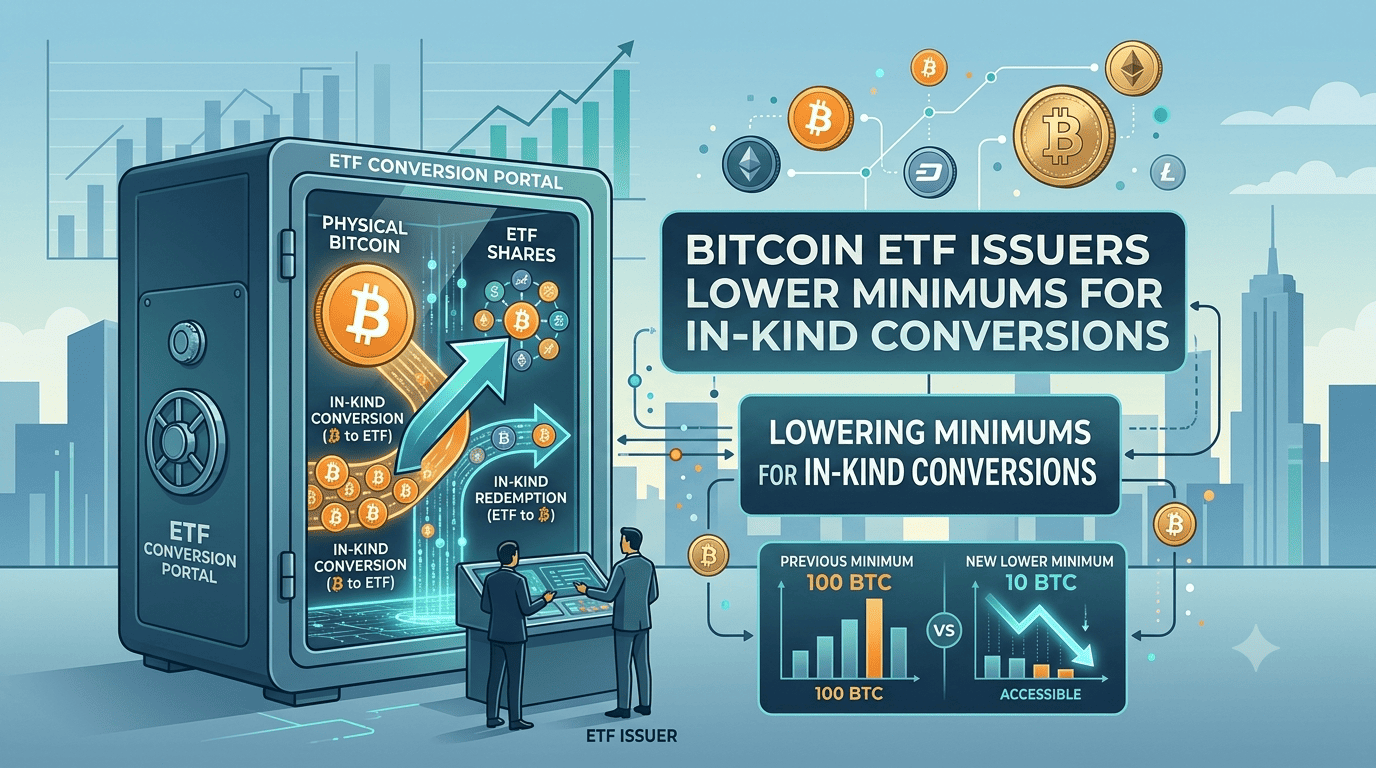
The landscape for institutional and high-net-worth Bitcoin ownership in the United States is undergoing a significant shift as major exchange-traded fund (ETF) issuers lower the barriers for in-kind asset conversions. Leading financial institutions, including BlackRock and Bitwise, have adjusted their entry requirements, allowing a broader range of investors to transition from private custody to regulated fund structures.
This movement follows a pivotal regulatory shift in July 2025, when the Securities and Exchange Commission (SEC) approved in-kind creations and redemptions for cryptocurrency exchange-traded products. Previously, these funds were restricted to cash-only transactions, a limitation that often created tax friction and operational hurdles for large-scale holders looking to move existing Bitcoin into the ETF ecosystem.
Key Developments in Bitcoin ETF Accessibility
- BlackRock and Bitwise have drastically reduced the minimum Bitcoin amounts required for in-kind conversions into their respective ETFs.
- In-kind transactions are becoming the preferred method for fund creation, with Grayscale reporting that these transfers accounted for 62% of its gross Bitcoin creations in June 2026.
- Rising physical security concerns, including a documented increase in violent crypto-related incidents, are driving holders toward institutional custody solutions.
- As of late August 2026, U.S. spot ETFs collectively hold nearly 6% of the total circulating Bitcoin supply.
Lowering the Barrier for Institutional Entry
BlackRock, the world’s largest asset manager, recently announced a substantial reduction in the minimum requirement for converting privately held Bitcoin into shares of its iShares Bitcoin Trust (IBIT). The threshold was lowered from $25 million to $1 million, a move that significantly expands the pool of eligible private investors and smaller institutional entities. According to reports from the firm, its conversion program has already processed more than $5 billion to date, signaling strong demand for the service.
Bitwise has taken an even more aggressive approach to lowering entry barriers. The issuer reduced its minimum threshold for in-kind Bitcoin conversions from $100 million to $3 million. This adjustment positions the Bitwise Bitcoin ETF (BITB) as a more accessible option for mid-tier institutional holders who may have previously found the nine-figure entry point prohibitive.
The trend extends beyond the ETF issuers themselves into the broader financial services sector. Morgan Stanley and Galaxy Digital have also adjusted their lending requirements for referred clients. The minimum lending threshold for these clients was reduced from $25 million to $5 million, further integrating Bitcoin into traditional wealth management and credit frameworks.
The Mechanics and Tax Advantages of In-Kind Transfers
The primary appeal of an in-kind conversion lies in its efficiency and potential tax benefits. In an in-kind transaction, a holder transfers their actual Bitcoin holdings to the trust in exchange for an equivalent value of ETF shares. This differs from a cash creation, where an investor must sell their Bitcoin for cash—potentially triggering a capital gains tax event—and then use that cash to purchase ETF shares.
By utilizing the in-kind model, holders may be able to defer taxable gains, as the exchange of the underlying asset for a representative share of a trust is often treated differently by tax authorities than a straight sale. This mechanism has become increasingly popular since the SEC removed cash-only restrictions in mid-2025. The impact of this regulatory change is evident in the data provided by Grayscale; in-kind transactions represented only 28% of its gross Bitcoin creations in March 2026, but that figure surged to 62% by June 2026.
This shift suggests that long-term holders are increasingly looking for ways to wrap their assets in a regulated security without the immediate friction of liquidation. The ability to move assets into a brokerage account while maintaining exposure to the underlying price of Bitcoin provides a level of convenience that was previously unavailable to the majority of the market.
Security Concerns and the Shift from Self-Custody
While the technical and tax advantages are significant, a growing driver for the migration toward ETFs is the physical safety of the holders. Self-custody requires individuals or entities to manage their own private keys, seed phrases, and hardware security. While this offers total control, it also makes the holder a potential target for physical coercion, theft, or home invasions.
Data from blockchain security firms highlights a troubling trend in physical crypto-related crime. Chainalysis documented 46 violent incidents related to cryptocurrency through late June 2026. The firm estimates that approximately $30 million was stolen through such means in the first half of the year alone. Furthermore, CertiK recorded 52 verified incidents in the same period, noting a dramatic rise in home invasions. According to CertiK, verified home invasions targeting crypto holders rose from just one incident to 20 year-over-year.
By moving assets into an ETF, the responsibility for securing the underlying Bitcoin shifts to institutional custodians. This removes the physical risk associated with holding private keys, as the assets are stored in enterprise-grade cold storage facilities that are not susceptible to individual home invasions or personal threats. For many high-net-worth individuals, the peace of mind provided by institutional custody is becoming worth the management fees associated with the ETF structure.
Market Concentration and Custodial Trends
The rapid growth of the ETF sector has led to a significant concentration of Bitcoin within a few regulated entities. As of August 25, 2026, the 13 US spot ETFs held a combined total of 1,246,336 BTC. This represents approximately 5.935% of the total 21 million Bitcoin supply that will ever exist. This concentration highlights the growing influence of Wall Street on the Bitcoin market.
Furthermore, the custody of these assets is even more concentrated. Current data suggests that between 80.8% and 84.1% of all U.S. Bitcoin ETF assets are connected to Coinbase in a custodial capacity. While this provides a standardized level of security and reporting, it also creates a central point of reliance for the majority of the regulated Bitcoin market in the United States.
The dominance of a single custodian like Coinbase, combined with the massive holdings of firms like BlackRock and Grayscale, marks a departure from the decentralized ethos of early Bitcoin adoption. However, for the institutional market, this centralized security model is viewed as a necessary step for broader adoption and integration into the global financial system.
What Happens Next
The reduction in conversion minimums by BlackRock and Bitwise is likely to trigger a new wave of inflows as smaller institutional players and wealthy individuals take advantage of the lower thresholds. As the market matures, other issuers may feel pressure to further lower their own requirements to remain competitive in the race for assets under management.
The ongoing rise in physical security threats may continue to push self-custody advocates toward hybrid or fully institutional models. While the “not your keys, not your coins” mantra remains a core tenet for many, the reality of physical risk is forcing a reevaluation of that philosophy for those with significant holdings.
Market participants will also be watching for any further regulatory guidance regarding the tax treatment of these in-kind transfers. If the tax-deferred status of these conversions remains stable, the trend of moving private Bitcoin into the ETF ecosystem is expected to persist, potentially leading to ETFs holding an even larger percentage of the total Bitcoin supply by the end of 2026.