
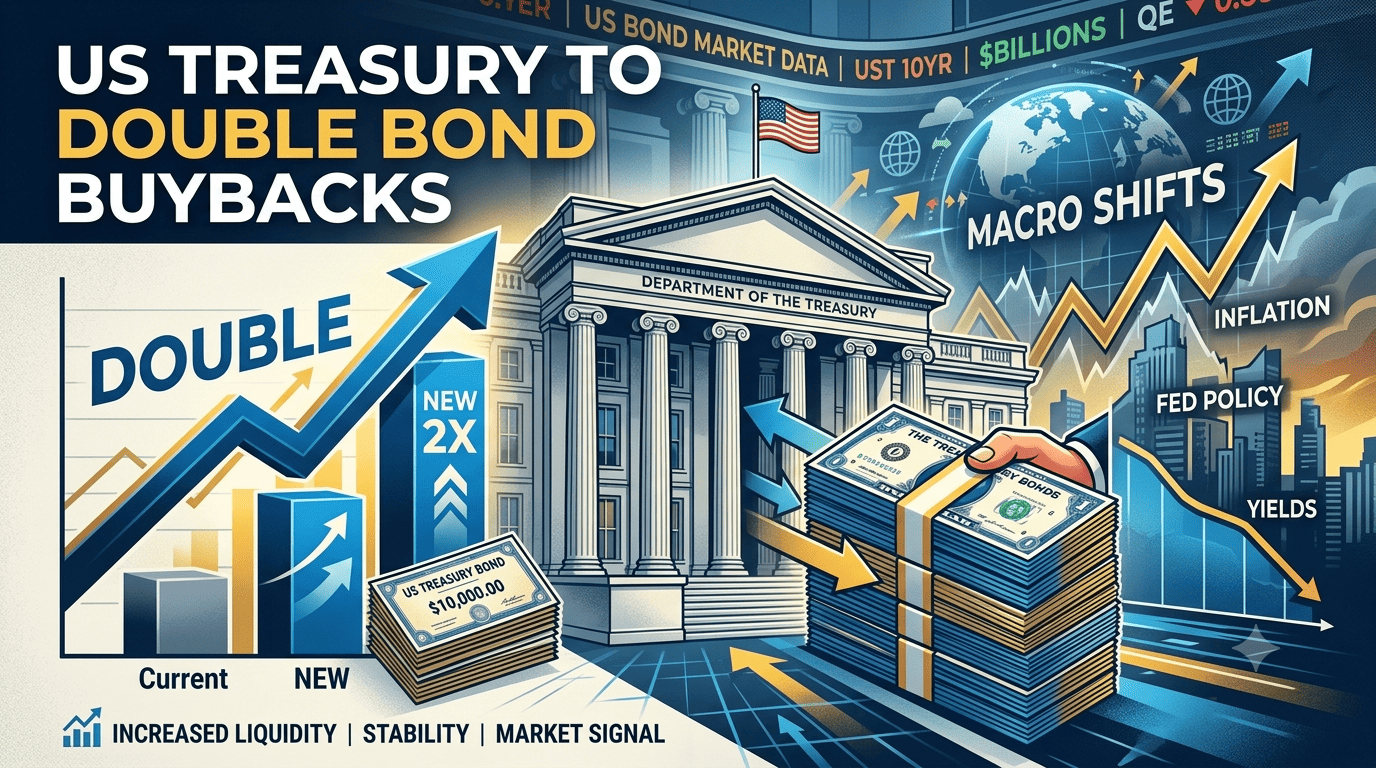
The United States Treasury Department has announced a strategic shift in its market operations, revealing plans to double the maximum size of its long-term bond buyback program. Starting September 9, the limit for selected operations will increase from $2 billion to $4 billion. This move comes as the broader financial landscape grapples with persistent federal deficits and a complex interest rate environment maintained by the Federal Reserve.
While the Treasury manages the volume and composition of federal debt, the Federal Reserve continues to oversee short-term money and real yields. The interplay between these two institutions creates a backdrop that significantly influences risk assets, including Bitcoin. As the Treasury prepares to ramp up its buyback efforts, market participants are closely watching how these liquidity measures will interact with the ongoing fiscal requirements of the United States government.
Key Developments in Treasury Operations
- The maximum size for selected long-term bond buyback operations will rise to $4 billion per operation beginning September 9.
- The Federal Reserve has maintained the target interest rate range at 3.50% to 3.75%, despite internal discussions regarding potential hikes.
- Treasury buybacks are intended to bolster liquidity for “off-the-run” bonds rather than reducing the overall federal debt supply.
- Projected net marketable borrowing for the second half of the year remains high, with $739 billion estimated for the July–September quarter.
Understanding the Mechanics of Treasury Buybacks
The Treasury Department’s decision to increase buyback limits is primarily a liquidity management tool. These operations involve the government purchasing older, less liquid securities—known as “off-the-run” bonds—and replacing them with new, benchmark “on-the-run” securities. This process is designed to ensure that the secondary market for government debt remains functional and efficient, particularly during periods of high volatility or shifting demand.
It is important to distinguish these buybacks from quantitative easing (QE) measures typically conducted by the Federal Reserve. Unlike QE, which involves the creation of new central bank reserves to purchase assets, Treasury buybacks are funded through the Treasury’s own cash balances or through the issuance of new debt. Consequently, the total supply of federal debt remains unchanged; only the maturity profile and liquidity of the outstanding bonds are altered.
The timing of this increase is notable, as the Treasury continues to navigate substantial borrowing needs. For the July–September quarter, the department projected $739 billion in privately held net marketable borrowing. This is expected to be followed by an additional $628 billion in the October–December quarter. These figures underscore the scale of the fiscal challenges and the necessity of maintaining a liquid market for government obligations.
The Federal Reserve and the Yield Environment
While the Treasury focuses on debt management, the Federal Reserve remains the primary arbiter of interest rate policy. Following its July meeting, the Fed opted to keep the federal funds rate within the 3.50% to 3.75% range. However, reports indicate that the decision was not unanimous, as some officials expressed a preference for a rate increase to further combat inflationary pressures.
The relationship between interest rates and bond yields has been particularly volatile in recent weeks. The 30-year Treasury yield, a critical benchmark for long-term borrowing costs, closed at 5.28% on August 18. Following the Treasury’s announcement regarding the expanded buyback program, the yield saw a temporary decline to 5.19%. However, this relief was short-lived, as the yield climbed back to 5.27% by September 2.
This volatility reflects the market’s sensitivity to the “term premium”—the additional compensation investors require for the risk of holding long-term debt. In an environment characterized by unpredictable economic conditions and significant fiscal expansion, investors often demand higher yields to offset the uncertainty of future inflation and interest rate paths.
Bitcoin’s Dual Narrative in a Macro Context
For the cryptocurrency market, and Bitcoin in particular, these macroeconomic shifts present a dual-sided narrative. Bitcoin is increasingly viewed through two primary lenses: as a sensitive risk asset and as a potential hedge against fiscal instability. The Treasury’s actions and the Fed’s rate decisions influence both of these perspectives.
First, Bitcoin is highly sensitive to real yields—the return on government bonds after adjusting for inflation. When real yields rise, the opportunity cost of holding a non-yielding asset like Bitcoin increases. This often leads to downward pressure on the price of Bitcoin and other technology-focused assets, as investors pivot toward the guaranteed returns offered by government debt.
Conversely, the persistent and growing federal deficit supports the narrative of Bitcoin as a “fiscal hedge.” As the Treasury Department continues to project hundreds of billions of dollars in new borrowing each quarter, concerns regarding the long-term sustainability of fiat currency and sovereign debt levels often intensify. In this context, Bitcoin’s fixed supply is seen by some as an alternative to the expanding supply of government-issued liabilities.
The Role of Liquidity and Market Stability
The increase in buyback operations to $4 billion is a clear signal that the Treasury is prioritized market stability. By providing a mechanism to exit older bond positions, the Treasury aims to prevent bottlenecks in the financial system that could lead to broader instability. This is particularly relevant given the massive volume of debt issuance scheduled for the remainder of the year.
Market analysts, including figures like Kevin Warsh, have often pointed to the delicate balance the Treasury must strike. On one hand, it must fund the government’s operations; on the other, it must ensure that the sheer volume of new debt does not overwhelm the market’s capacity to absorb it. The buyback program acts as a buffer, potentially smoothing out the impact of large-scale issuance on bond yields.
However, the effectiveness of these measures remains a point of observation. The fact that the 30-year yield returned to its previous highs shortly after the buyback announcement suggests that broader market forces—such as inflation expectations and the Fed’s “higher for longer” stance—may carry more weight than the Treasury’s liquidity injections.
What Happens Next
As the September 9 start date for the expanded buybacks approaches, the market will be watching for immediate impacts on bond liquidity and yield spreads. The Treasury’s ability to successfully manage the transition from $2 billion to $4 billion operations will be a key indicator of its capacity to handle the heavy borrowing schedule projected for the fourth quarter.
For Bitcoin, the focus remains on the Federal Reserve’s next move. If the Fed maintains its current rate range or signals a shift toward a more accommodative stance, the pressure from high real yields may subside, potentially providing a tailwind for risk assets. However, if inflation remains sticky and officials push for further hikes, the opportunity cost of holding Bitcoin could remain elevated.
Furthermore, the ongoing discussion regarding the US fiscal trajectory will likely keep the “hedge” narrative alive. As the Treasury continues to navigate the complexities of debt management and market liquidity, the role of decentralized assets in a macro-heavy environment will continue to be a central theme for investors and policymakers alike.