
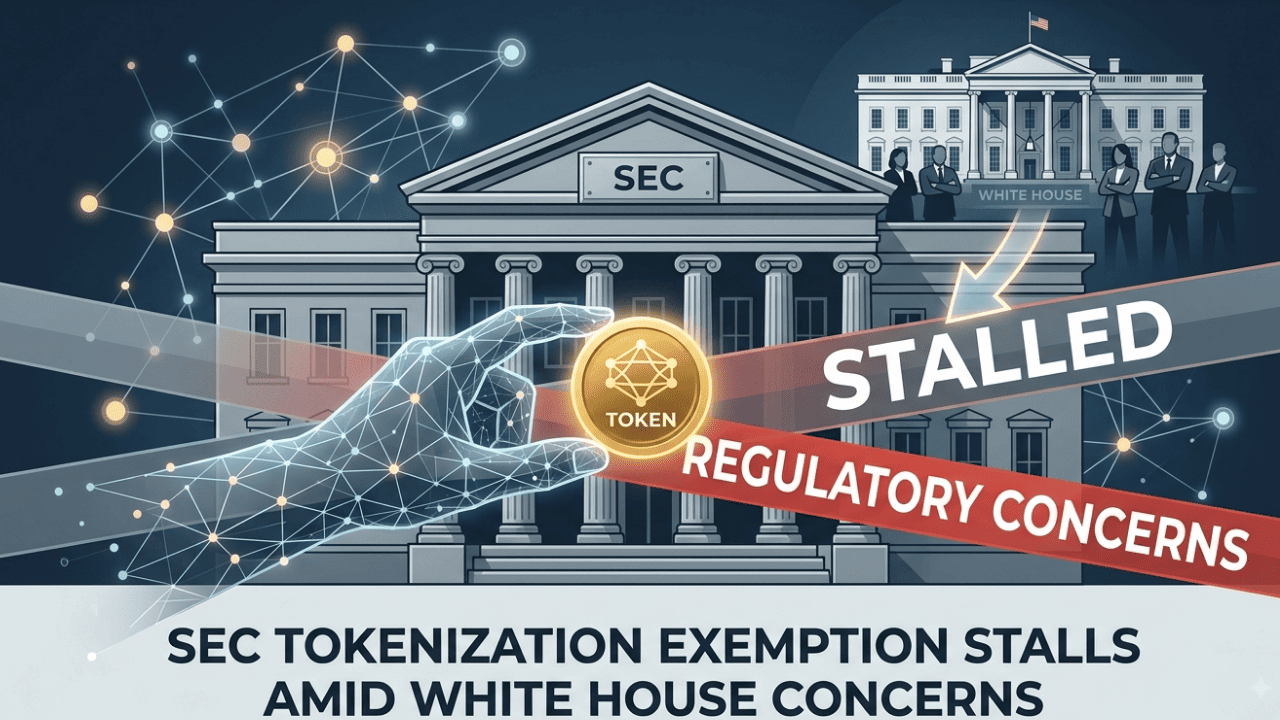
The U.S. Securities and Exchange Commission (SEC) has indefinitely postponed the rollout of a proposed **SEC tokenization exemption** that was intended to provide a regulatory sandbox for blockchain-based assets. The decision follows reports of mounting concerns from both Wall Street financial institutions and the White House regarding market stability and oversight.
Key Points:
- 1 planned open meeting titled “Reg Crypto” was abruptly canceled on Friday.
- Wall Street firms cited concerns over systemic risk and oversight standards.
- The White House requested a comprehensive review of the framework.
The SEC’s planned “Reg Crypto” open meeting, which was scheduled for Friday, was intended to be a landmark session for the digital asset industry. However, sources familiar with the matter indicate that the commission pulled the **SEC tokenization exemption** from the agenda at the eleventh hour. This exemption was designed to allow certain blockchain-based financial products to operate under limited relief from traditional securities laws.
According to reports from Fox Business, the sudden pivot reflects a rift between the agency’s leadership and broader administrative goals. The proposed framework would have potentially allowed for the streamlined issuance of tokenized securities, a move long sought by the fintech sector but viewed with skepticism by legacy banking institutions. The delay signals a continuing struggle to balance technological advancement with the existing legal infrastructure governing capital markets.
SEC Tokenization Exemption Stalled

The core of the conflict centers on the “innovation exemption,” which would have provided a path for firms to experiment with distributed ledger technology (DLT) without the immediate burden of full registration. Wall Street representatives have reportedly lobbied against the measure, arguing that it could create an unlevel playing field. There are fears that such an exemption might introduce unforeseen risks into the traditional financial plumbing if not properly vetted.
White House officials have also weighed in, expressing a desire for a more cohesive approach to digital asset regulation rather than piecemeal exemptions. This intervention highlights the political sensitivity surrounding crypto policy as the current election cycle intensifies. The delay of the **SEC tokenization exemption** suggests that the commission may be forced to recalibrate its approach to align with the broader Treasury Department and executive branch strategies for financial stability.
White House Policy Influence

The postponement of the “Reg Crypto” meeting is the latest in a series of delays regarding U.S. digital asset policy. While jurisdictions like the European Union have implemented the Markets in Crypto-Assets (MiCA) regulation, the U.S. remains fragmented. The **SEC tokenization exemption** was seen as a potential bridge between the current restrictive environment and a modernized financial system, but its future now remains uncertain amid high-level administrative pushback.
Industry analysts suggest that the SEC’s hesitancy also stems from recent legal setbacks and internal divisions. The agency has faced significant pushback in various court cases regarding its “regulation by enforcement” strategy. Providing a formal **SEC tokenization exemption** requires a level of clarity that the agency may not yet be prepared to offer, especially if it risks undermining its stance in ongoing litigation against major digital asset exchanges.
Institutional Market Impact
Major financial institutions like BlackRock and Franklin Templeton have already moved forward with tokenized funds, such as the BUIDL fund on the Ethereum blockchain. However, these firms generally operate within existing, more restrictive frameworks that involve significant compliance costs. A broad **SEC tokenization exemption** could potentially open the market to smaller competitors, a prospect that has caused unease among established market participants who prefer the status quo.
The rise of real-world asset (RWA) tokenization remains a primary focus for the digital asset industry, with trillions of dollars in traditional assets potentially moving on-chain. Without a clear regulatory path, however, many firms are hesitant to commit full resources to the technology. The current delay reinforces the perception that the U.S. regulatory environment for crypto remains one of the most challenging in the global market.
Moving forward, the SEC is expected to re-evaluate the feedback from the White House and industry stakeholders before rescheduling any discussions on the exemption. Market observers will be watching closely to see if the commission attempts to integrate these exemptions into a larger rule-making package or if the proposal will be shelved indefinitely in favor of more stringent oversight. The timeline for a new “Reg Crypto” meeting has not yet been established.