
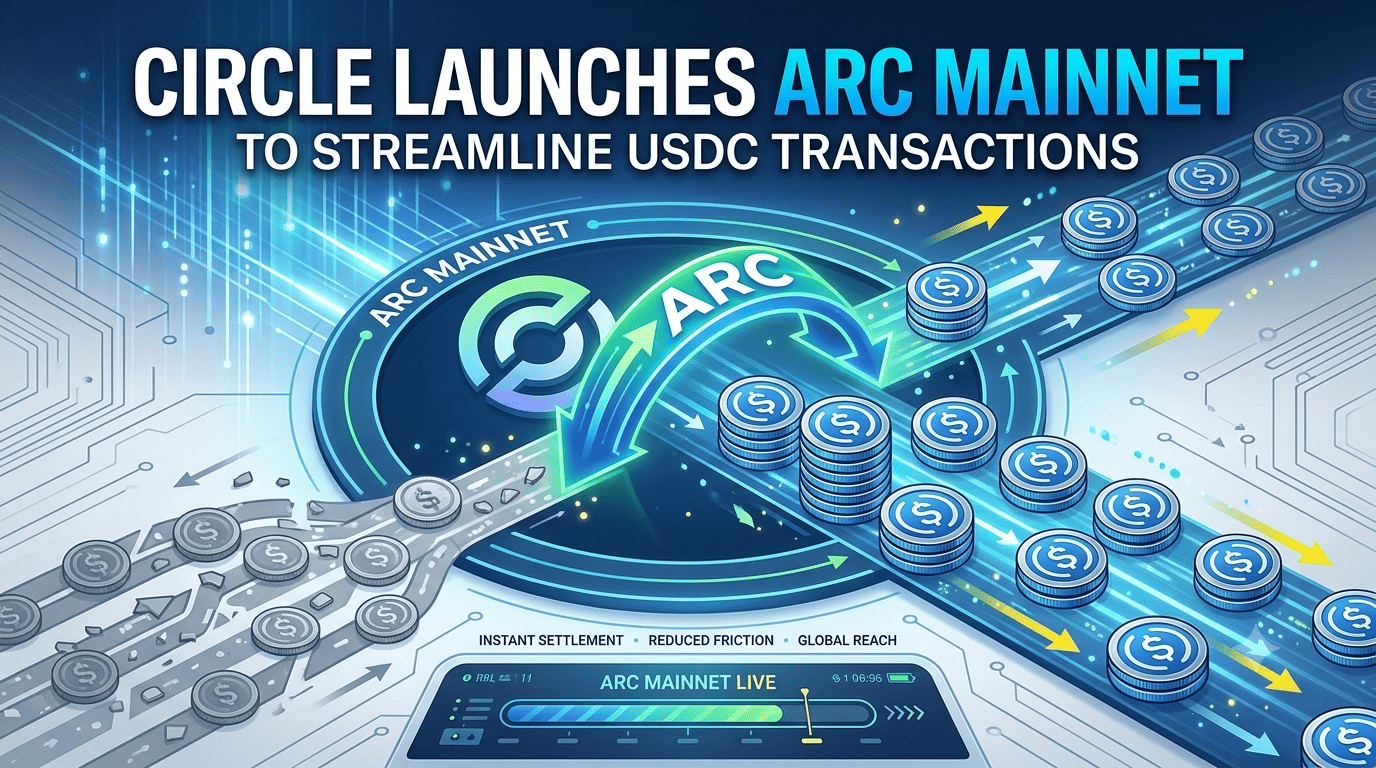
Circle, the financial technology firm responsible for the issuance of the USDC stablecoin, officially transitioned its proprietary Layer-1 blockchain, Arc, to mainnet status on September 16, 2026. The launch represents a significant shift in the company’s infrastructure strategy, moving from a reliance on third-party networks to a dedicated environment optimized specifically for stablecoin liquidity and institutional payments.
The Arc network is designed as an Ethereum-compatible blockchain that prioritizes speed and user experience by addressing several long-standing friction points in the decentralized finance ecosystem. By providing a native environment for USDC, Circle aims to consolidate its position in the competitive stablecoin market, where it continues to vie for market share against established incumbents.
Key Developments in the Arc Launch
- Gasless Transaction Model: Arc allows users to settle transaction fees using their existing USDC balances, removing the traditional requirement to hold a separate native gas token like Ether (ETH).
- Institutional Validator Set: The network operates with a permissioned group of validators, including major global financial entities such as BlackRock, DTCC, Visa, and Mastercard.
- High-Speed Finality: Technical specifications for the network indicate that transactions are designed to reach finality in less than one second, targeting real-time payment use cases.
- Developer Accessibility: While the validator set remains permissioned to ensure regulatory and operational standards, the network remains open for developers to build and deploy decentralized applications.
Eliminating the Gas Token Barrier
One of the primary technical hurdles for mainstream stablecoin adoption has been the necessity of a secondary asset to facilitate transfers. On most Ethereum-compatible networks, a user wishing to send a stablecoin must also possess the network’s native utility token to pay for the computational resources required for the transaction. This requirement often creates a barrier for new users who may not wish to manage multiple volatile assets.
The Arc mainnet addresses this by integrating a fee mechanism that accepts USDC directly. This “gasless” experience is intended to mirror the simplicity of traditional electronic payment systems while retaining the benefits of blockchain settlement. By allowing the payment asset to serve as the fee asset, Circle is attempting to simplify the onboarding process for both retail users and enterprise clients who require predictable cost structures.
This architectural choice is particularly relevant for high-volume payment processors and merchants. In a traditional blockchain environment, these entities would need to maintain a treasury of gas tokens, which introduces accounting complexities and exposure to price volatility. Arc’s model seeks to eliminate these overhead costs, potentially making stablecoin integration more attractive for traditional commerce.
Institutional Integration and Network Security
Unlike fully permissionless networks where anyone can participate in securing the chain, Arc utilizes a curated cohort of validators. This founding group includes some of the most prominent names in traditional finance and payments, such as BlackRock, the Depository Trust & Clearing Corporation (DTCC), Visa, Mastercard, and Standard Chartered. The involvement of these entities suggests a focus on compliance and institutional-grade reliability.
The use of a permissioned validator set allows the network to achieve performance metrics that are often difficult to maintain on more decentralized chains. Circle has reported that the network is optimized for sub-second finality, a requirement for point-of-sale transactions and high-frequency institutional settlements. This speed is a critical component of Circle’s broader goal to position USDC as a viable alternative to legacy settlement rails.
Despite the restricted nature of the validator set, Circle has emphasized that the application layer remains open. This hybrid approach is intended to provide the security and oversight required by institutional partners while fostering an ecosystem where third-party developers can innovate. During the private network phase in August 2026, Circle noted that more than 100 ecosystem and institutional builders were already active on the platform, signaling early interest from the development community.
Strategic Positioning in the Stablecoin Market
The launch of Arc comes at a time of intense competition within the stablecoin sector. As of mid-2026, the market remains dominated by Tether (USDT), which held a circulation of approximately $184.6 billion at the end of June. In contrast, USDC circulation stood at $73.3 billion during the same period. By launching its own dedicated blockchain, Circle is attempting to differentiate its product through superior utility and deeper integration with traditional financial systems.
The history of Arc dates back to its public testnet opening on October 28, 2025. The transition to mainnet follows nearly a year of testing and refinement, during which Circle sought to balance the needs of the crypto-native community with the stringent requirements of its institutional partners. The move to a proprietary Layer-1 allows Circle to have greater control over the roadmap and feature set of the environment where its primary asset circulates.
Furthermore, the Ethereum compatibility of Arc ensures that existing tools, wallets, and smart contracts can be ported to the new network with minimal friction. This compatibility is essential for maintaining liquidity and ensuring that the broader DeFi ecosystem can interact with the new chain without requiring extensive re-engineering.
Privacy Features and Future Roadmap
While the mainnet is now live, certain features remains in the development pipeline. Circle has identified the “Arc Privacy Sector” and “Stablecoin Services” as planned components that are currently unavailable. These opt-in privacy features are expected to provide users and institutions with the ability to conduct transactions with enhanced confidentiality, a feature often requested by corporate entities concerned with trade secrecy and data protection.
The implementation of these privacy tools will likely be a delicate balancing act for Circle, as the company must ensure that any privacy-enhancing technology complies with global Anti-Money Laundering (AML) and Know Your Customer (KYC) regulations. The “planned” status of these features suggests that the technical and regulatory frameworks for their deployment are still being finalized.
What Happens Next
Following the mainnet launch, the immediate focus for the Arc ecosystem will be the migration of liquidity and the activation of the 100+ builders who participated in the private phase. The market will be watching to see how quickly institutional partners like Visa and Mastercard begin utilizing the network for actual settlement tasks rather than just acting as validators.
The success of Arc will likely be measured by its ability to close the circulation gap with Tether and its adoption rate among non-crypto-native enterprises. As the network matures, the rollout of the Arc Privacy Sector will be a key milestone to watch, as it could unlock new use cases for sensitive corporate transactions that are currently avoided on transparent public ledgers.
Additionally, the broader industry will observe whether other stablecoin issuers follow suit by launching their own dedicated chains or if they continue to rely on existing general-purpose networks. For now, Circle’s move marks a significant bet on the idea that the future of stablecoins lies in vertically integrated infrastructure tailored to the needs of global finance.