
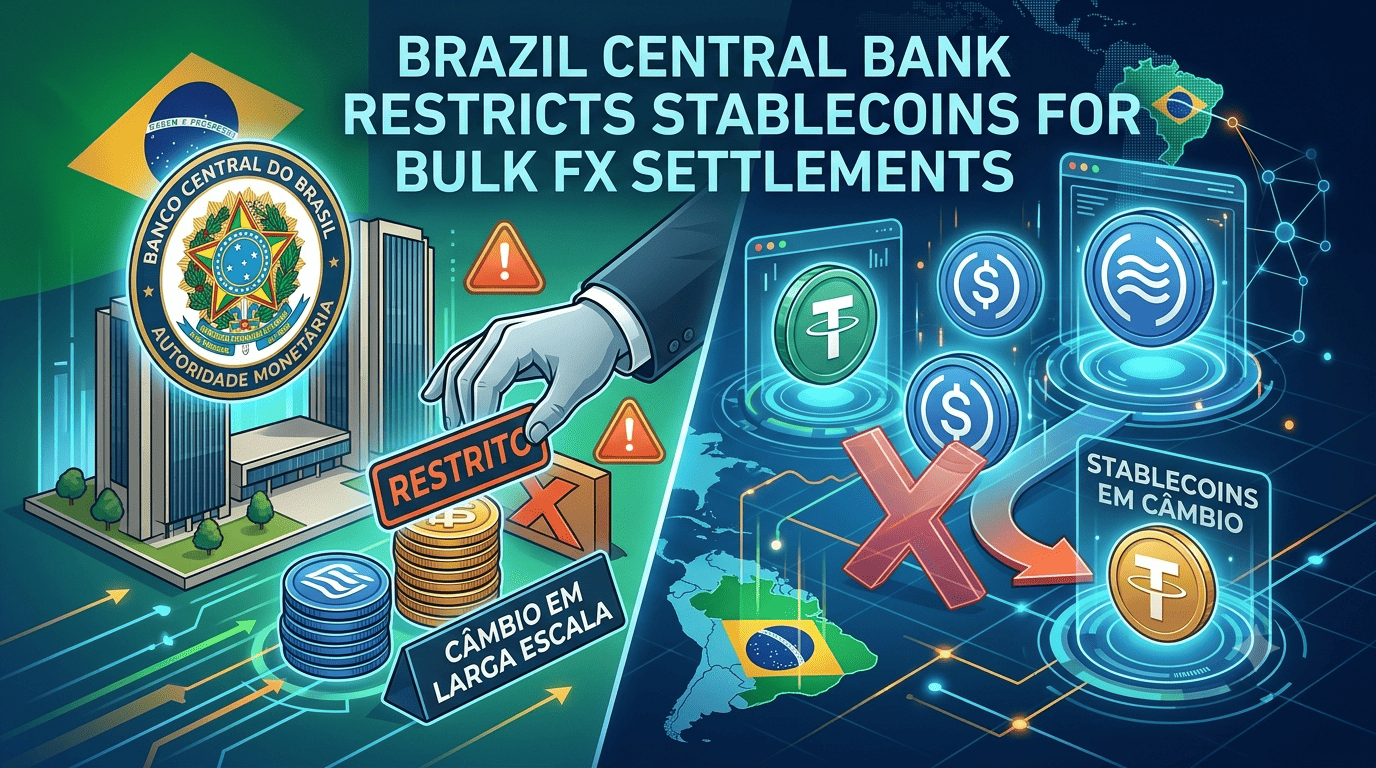
The Central Bank of Brazil has introduced a significant regulatory shift that limits the use of digital assets in the nation’s foreign exchange infrastructure. Through the issuance of Resolution 561, the monetary authority has formally barred the use of stablecoins and other virtual assets for the settlement of aggregated electronic foreign exchange (eFX) flows. This move marks a tightening of the oversight mechanisms governing how payment providers interact with international counterparties.
The new directive specifically targets the settlement leg of transactions between regulated Brazilian foreign-exchange providers and their partners located overseas. Under the previous informal arrangements, many providers utilized the speed and low cost of stablecoins to finalize bulk payments. However, starting October 1, these entities will be required to process such settlements through licensed foreign exchange transactions or qualifying non-resident accounts denominated in Brazilian reals.
While the regulation introduces strict hurdles for bulk settlements, it does not eliminate the use of digital assets for all cross-border activity. Individual international transfers conducted via virtual assets remain permitted under the existing regulatory framework. The central bank’s focus appears to be on the systemic level of the exchange market rather than individual consumer behavior.
Key Developments in Resolution 561
- The regulation prohibits the use of stablecoins for settling aggregated eFX flows between local providers and overseas counterparties.
- Effective October 1, all such settlements must utilize licensed FX transactions or authorized non-resident real accounts.
- The rule eliminates a common “shortcut” where providers bundled multiple small payments into a single stablecoin settlement to avoid traditional banking fees.
- Individual virtual asset transfers remain unaffected, preserving the current rights of retail users for direct international payments.
Understanding Resolution 561 and the eFX Framework
The eFX model is a cornerstone of Brazil’s digital economy, facilitating high-volume, low-value transactions that power modern consumer habits. This framework is typically used for services such as international streaming subscriptions, online gaming platforms, and global e-commerce marketplaces. Because these transactions involve small amounts of money moving across borders, efficiency in the settlement process is a primary concern for payment processors.
Prior to the introduction of Resolution 561, many payment providers utilized a bulk settlement strategy. This involved consolidating thousands of individual transactions into a single large sum, which was then transferred to an overseas counterparty using stablecoins like Tether (USDT) or Circle (USDC). This method allowed companies to bypass the complexities and delays often associated with the traditional correspondent banking system.
The Central Bank of Brazil’s decision to close this “shortcut” is rooted in a desire for greater financial transparency. By requiring these settlements to pass through formal exchange channels, the regulator gains increased visibility into the flow of capital leaving and entering the country. This move aligns with the authority granted to the central bank under Brazil’s 2022 virtual assets law, which categorized certain crypto operations as foreign-exchange activities.
The Dominance of Stablecoins in the Brazilian Market
The impact of this regulation is magnified by the sheer scale of stablecoin adoption within Brazil. Data indicates that stablecoins have become the preferred medium for digital asset activity in the country, often overshadowing volatile cryptocurrencies like Bitcoin. Between August 2019 and December 2025, declared stablecoin transactions in Brazil reached a staggering R$1.13 trillion.
During this period, stablecoins accounted for approximately 72% of all declared cryptocurrency activity. This trend has only accelerated over time; by 2025, stablecoins represented 80% of the total declared crypto volume. Within this niche, Tether (USDT) maintains a dominant position, commanding roughly 89% of the total stablecoin volume in the Brazilian market. The widespread reliance on these assets for liquidity and settlement explains why the central bank has prioritized defining their role in the formal financial system.
By targeting the aggregated settlement leg, the central bank is addressing a specific point of friction where the digital asset world meets the traditional regulated economy. While providers are still permitted to net and consolidate their internal balances, the final transfer to a foreign entity must now adhere to traditional banking standards, effectively removing the blockchain-based settlement option for these specific corporate flows.
Economic Implications and Operational Costs
The transition away from stablecoin-based bulk settlements is expected to have tangible economic consequences for payment providers. The traditional foreign exchange system in Brazil involves several layers of costs that stablecoins previously allowed companies to mitigate. These include the Financial Transaction Tax (IOF), fees charged by correspondent banks, and the costs associated with the SWIFT messaging network.
A study conducted by the Bank of Italy highlighted the cost disparities in international transfers. The research found that while the actual blockchain transfer costs for assets like USDC are often marginal, the total expense of a 200-dollar transfer can range from 0.3% to 9% when accounting for currency conversion and local payment infrastructure. By forcing eFX settlements back into the traditional system, the Central Bank of Brazil may be reintroducing these higher overheads into the payment ecosystem.
Industry observers suggest that the removal of the stablecoin settlement shortcut could force providers to reassess their pricing models. If the costs of compliance and traditional settlement rise, these expenses may eventually be reflected in the fees charged to consumers or the exchange rates offered by e-commerce platforms. However, the central bank maintains that the trade-off is necessary to ensure the integrity and monitoring of the nation’s financial borders.
What Happens Next
As the October 1 deadline approaches, payment providers and financial institutions in Brazil must adjust their operational workflows to comply with Resolution 561. This involves establishing or reinforcing relationships with licensed foreign exchange dealers and ensuring that non-resident accounts are properly configured to handle real-denominated settlements.
The central bank is expected to monitor the transition closely to ensure that the removal of the stablecoin shortcut does not cause significant disruptions to the eFX market. Regulators will likely look for signs of whether the increased costs are being absorbed by providers or passed on to the public. Furthermore, the move sets a precedent for how the BCB might handle other intersections of decentralized finance and traditional exchange controls.
In the long term, the industry will be watching to see if this regulation encourages the development of more sophisticated, regulated digital payment solutions that satisfy the central bank’s transparency requirements while maintaining the efficiency of blockchain technology. For now, the era of using stablecoins as a primary bulk settlement tool for Brazilian eFX flows is drawing to a close, replaced by a more rigid, traditional framework.