
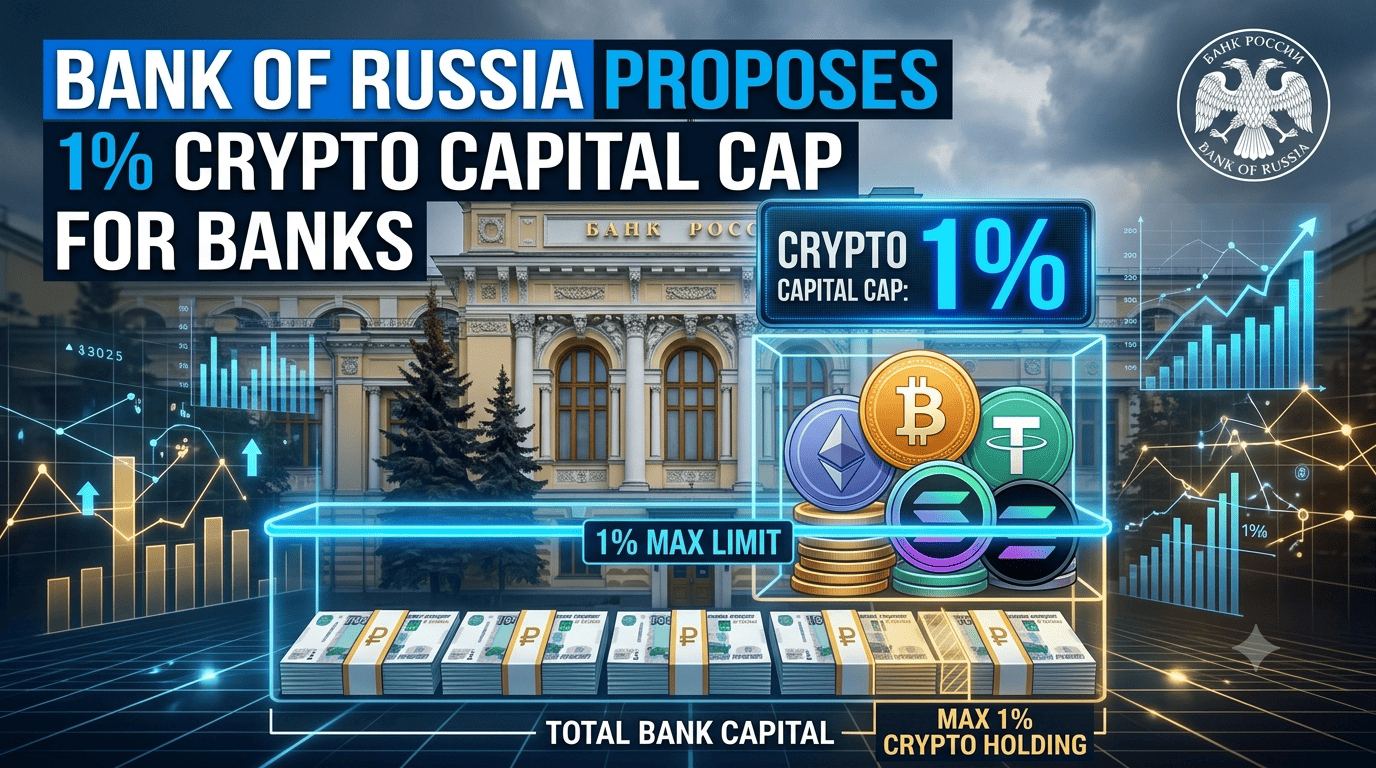
The Bank of Russia has moved to formalize its stance on digital asset exposure within the national banking sector by introducing a comprehensive draft regulation. This proposal, unveiled on September 18, 2026, seeks to establish a strict ceiling on the amount of cryptocurrency and related instruments that financial institutions can hold relative to their own capital. By implementing a 1% capital cap, the central bank aims to insulate the traditional financial system from the inherent volatility and perceived risks associated with the decentralized digital asset market.
This regulatory move is part of a broader effort by Russian authorities to define the boundaries of the crypto-economy within the country’s borders. The draft regulation does not merely set a limit but introduces a complex framework of risk-weighting and reporting requirements designed to ensure that banks maintain significant buffers against potential losses in the digital asset space. As the global regulatory landscape for crypto continues to evolve, the Russian central bank’s approach reflects a cautious strategy focused on systemic stability.
Key Developments in the Russian Banking Proposal
- The introduction of a 1% cap on cryptocurrency holdings relative to a bank’s own funds (capital).
- The creation of two new regulatory ratios, N31 and N32, to monitor individual and consolidated banking group exposures.
- A punitive 1,250% risk weight assigned to direct crypto holdings and liable client positions.
- Specific exemptions for client custody assets, provided the bank bears no liability for potential losses or seizures.
The Mechanics of the 1% Capital Ceiling
At the heart of the Bank of Russia’s proposal is a restrictive ceiling that limits a bank’s total exposure to digital assets to just 1% of its own funds. It is important to distinguish that this percentage applies to the institution’s capital—its “own funds”—rather than its total assets. This distinction is significant because capital typically represents a much smaller portion of a bank’s balance sheet than its total assets, making the 1% limit a highly conservative threshold.
To enforce this limit, the regulator has proposed two new financial ratios. The first, designated as N31, is intended for individual credit institutions. The second, N32, is designed for consolidated banking groups. These ratios will serve as the primary metrics for assessing whether a bank is operating within the permitted boundaries of digital asset exposure. By monitoring these figures, the central bank can gain a granular view of how much capital is being risked in the crypto market across the entire banking sector.
The scope of the 1% cap is broad, covering a wide array of financial instruments. According to the draft, the ceiling applies to direct holdings of cryptocurrencies, indirect investments through third-party vehicles, and derivative products whose value is tied to the price of digital assets. Furthermore, the regulation encompasses traditional financial instruments, such as loans or bonds, if their underlying value is dependent on the performance of cryptocurrencies or foreign digital instruments. This comprehensive definition ensures that banks cannot circumvent the cap through complex financial engineering or indirect exposure.
Defining Crypto Exposure and Risk Weighting
Beyond the 1% cap, the Bank of Russia’s draft regulation introduces a rigorous risk-weighting system that could significantly impact the cost of holding digital assets. For a bank’s own-account exposure, as well as for client positions for which the bank assumes liability, the regulator has proposed a risk weight of 1,250%. In the context of banking capital requirements, a 1,250% risk weight is exceptionally high, essentially requiring banks to hold capital equal to the full value of the asset to cover potential risks.
This high risk-weighting factor serves as a powerful economic deterrent. It suggests that the central bank views these assets as carrying the highest possible level of risk to an institution’s solvency. By making it capital-intensive to hold crypto, the regulator effectively discourages banks from building large proprietary positions in the market. This approach aligns with international standards suggested by global financial bodies, which often recommend high capital charges for unbacked digital assets.
The draft also addresses the issue of netting, which allows institutions to offset long positions with short positions to reduce their total reported exposure. However, the Bank of Russia’s proposal is restrictive in this regard. Netting will only be permitted in limited circumstances and only within a specific, qualifying lower-risk category of instruments. This limitation ensures that banks cannot use hedging strategies to mask the true scale of their digital asset activities or to bypass the 1% ceiling.
Custody and Liability Framework
A critical component of the new regulation involves how banks handle client assets. The Bank of Russia has made a clear distinction between assets held in custody where the bank is liable for losses and those where it is not. Client custody assets are excluded from the 1% capital cap calculation only if the bank does not bear any liability for the seizure of those assets or for losses resulting from restrictions placed upon them.
For these non-liable client custody positions, the draft assigns a much lower risk weight of 50% for capital-adequacy calculations. This lower weight reflects the reduced risk to the bank’s own capital when it acts merely as a neutral intermediary or custodian without providing guarantees to the client. This part of the proposal may provide a pathway for banks to offer digital asset services to their customers without significantly impacting their own capital ratios, provided they can legally and operationally insulate themselves from liability.
However, if a bank is found to be liable for the safety or availability of client-held crypto, those assets are treated with the same 1,250% risk weight as the bank’s own holdings. This creates a strong incentive for financial institutions to clearly define their terms of service and ensure that clients understand the risks involved in third-party custody. The regulator’s focus on liability underscores a desire to prevent the banking sector from becoming a backstop for the inherent risks of the crypto market.
Strategic Context and Implementation Timeline
The introduction of this draft regulation is a milestone in Russia’s ongoing efforts to establish a rulemaking framework for the cryptocurrency market. While the country has seen various legislative attempts to regulate or even ban digital assets in the past, this proposal provides a technical roadmap for how the traditional banking sector will interact with this new asset class. It reflects a shift toward managed integration rather than outright exclusion, albeit with very tight controls.
The timeline for these changes is already being mapped out. The Bank of Russia plans to officially publish the regulation in the fourth quarter of 2026. Once published, the requirements are expected to take effect just 10 days later. This rapid implementation suggests that the central bank is keen to have these safeguards in place as the market continues to develop.
Following the implementation, banks will be required to begin a new phase of transparency. Starting in January 2027, financial institutions will be expected to report their instrument turnover and the values of their N31 and N32 ratios to the regulator. This reporting cycle will provide the Bank of Russia with the data necessary to monitor compliance and assess whether the 1% cap is achieving its goal of maintaining financial stability.
What Happens Next
As the fourth quarter of 2026 approaches, the Russian banking sector will likely begin preparing for the transition to these new capital requirements. Banks currently holding digital assets or offering crypto-linked products will need to evaluate their portfolios to ensure they do not exceed the 1% own-funds threshold. The high risk-weighting of 1,250% may lead some institutions to divest from direct holdings or restructure their service offerings to minimize capital impact.
The period between the publication of the regulation and the start of reporting in January 2027 will be a critical window for the industry. Market participants will be watching closely to see if any further clarifications are issued regarding the “lower-risk category” that allows for limited netting. Additionally, the legal frameworks surrounding custody agreements will likely undergo scrutiny as banks seek to qualify for the 50% risk weight by limiting their liability for client assets.
Ultimately, the success of this regulation will depend on how effectively the N31 and N32 ratios capture the true risk profile of the banking sector’s crypto activities. While the 1% cap is a clear barrier, the evolving nature of digital finance may present new challenges that require the Bank of Russia to adjust these ratios or risk weights in the future. For now, the proposal stands as one of the most definitive steps taken by a major central bank to quantify and limit the intersection of traditional banking and the cryptocurrency market.