
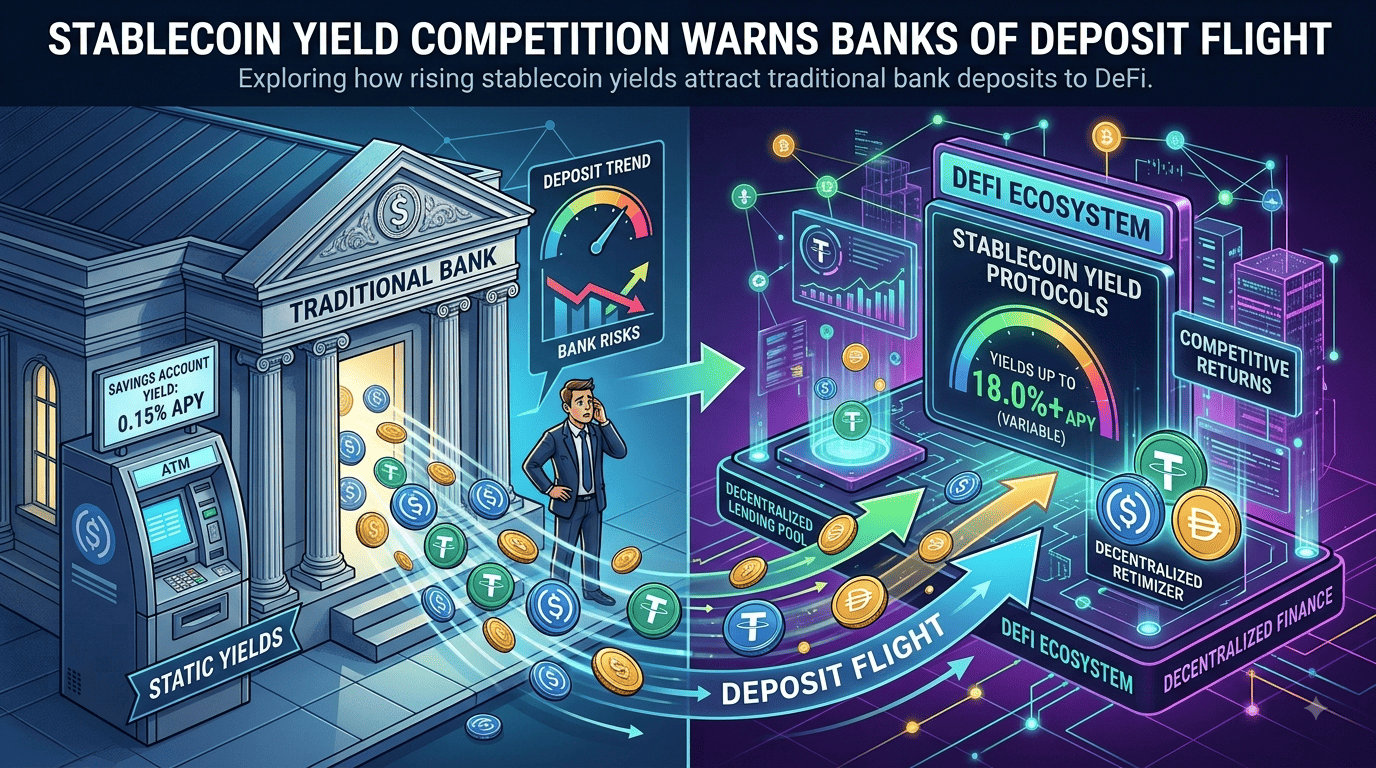
Traditional financial institutions and digital asset firms are escalating their dispute over stablecoin yield competition, as bankers argue that high-interest crypto products threaten the stability of the global deposit system. The intensifying debate centers on whether decentralized assets should be allowed to offer market-leading returns that far outpace the interest rates provided by legacy savings accounts.
Key Points:
- 5 percent yields or higher are commonly offered by stablecoins compared to the sub-1 percent national average for bank savings.
- Bankers claim deposit outflows to digital assets could restrict credit availability for mortgages and small businesses.
- Regulatory bodies are increasingly siding with banks to protect the fractional reserve banking model from liquidity shocks.
The conflict between traditional finance and the decentralized sector has reached a new boiling point as interest rate environments shift globally. Banking lobbyists are increasingly vocal about the risks of “deposit flight,” a phenomenon where consumers move liquid funds from low-yield bank accounts into yield-bearing stablecoins. This shift is not merely a competitive hurdle but, according to banking executives, a systemic risk that could reduce the structural liquidity necessary for the financial system to function as it has for generations.
Industry data indicates that while traditional banks have been slow to pass central bank interest rate hikes to their depositors, stablecoin issuers and decentralized finance (DeFi) protocols have moved quickly to capture market share. This disparity has fueled a narrative of financial inclusion from the crypto sector, while the banking industry frames the movement of capital as an unregulated shadow banking threat. The argument that keeping deposits within the traditional system is essential for economic stability is reportedly gaining significant ground among global policymakers.
Lobbyists Combat Capital Outflows

The core of the banking sector’s argument rests on the historical role of low-cost deposits. For decades, these deposits have provided the stable, inexpensive capital necessary for commercial banks to issue loans and support broad economic growth. If a significant portion of this capital migrates to stablecoins to seek higher returns, the cost of borrowing for the general public could rise significantly. A report by Reuters highlights that central banks are now closely monitoring how these capital flows might impact the transmission of monetary policy and the overall health of commercial lending.
Bankers are successfully arguing that the “good of the financial system” depends on a captive deposit base that does not fluctuate based on the volatility of the crypto markets. This perspective suggests that the traditional banking model, while offering lower yields to the consumer, provides a public utility in the form of credit stability that stablecoins cannot replicate. As this argument gains traction, regulators are looking at ways to ensure that digital assets do not enjoy a competitive advantage by circumventing the heavy compliance costs associated with traditional deposit-taking.
Stablecoin yield competition mechanics

Conversely, stablecoin proponents argue that the current banking model relies on rent-seeking behavior, where institutions profit from the wide spread between central bank rates and the pittance paid to savers. Digital asset firms contend that the stablecoin yield competition is a natural result of blockchain technology allowing for more efficient distribution of value. By removing the overhead of legacy infrastructure, these firms can pass a larger share of interest income directly to the asset holders, challenging the status quo of the banking industry.
This “clash of traditions” is now moving into the halls of government, as lawmakers in the United States and Europe weigh the benefits of financial innovation against the stability of the existing order. The stablecoin yield competition has forced a re-evaluation of what constitutes a “deposit” and whether stablecoin issuers should be subject to the same reserve requirements and insurance premiums as commercial banks. The outcome of these discussions will likely determine the future profitability of both the banking and crypto sectors.
Legislative Pressure On Reserves
The tension comes at a time when the Securities and Exchange Commission (SEC) and other global regulators are already scrutinizing the reserves of major issuers like Circle and Tether. The introduction of yield-bearing stablecoins, which function similarly to money market funds, has complicated the legal classification of these assets. Historically, whenever a new financial instrument has threatened the deposit base of commercial banks, it has eventually faced stringent capital requirement regulations to level the playing field.
Market analysts expect that the resolution of this clash will likely result in a hybrid regulatory framework. Future legislation may mandate that stablecoin issuers hold specific types of high-quality liquid assets, which would effectively narrow the stablecoin yield competition by increasing the cost of compliance and reducing the margins available for distribution to holders. As the divide between tradition and technology-driven finance narrows, the battle over the consumer’s primary cash account remains the most contentious frontier of modern financial regulation.