
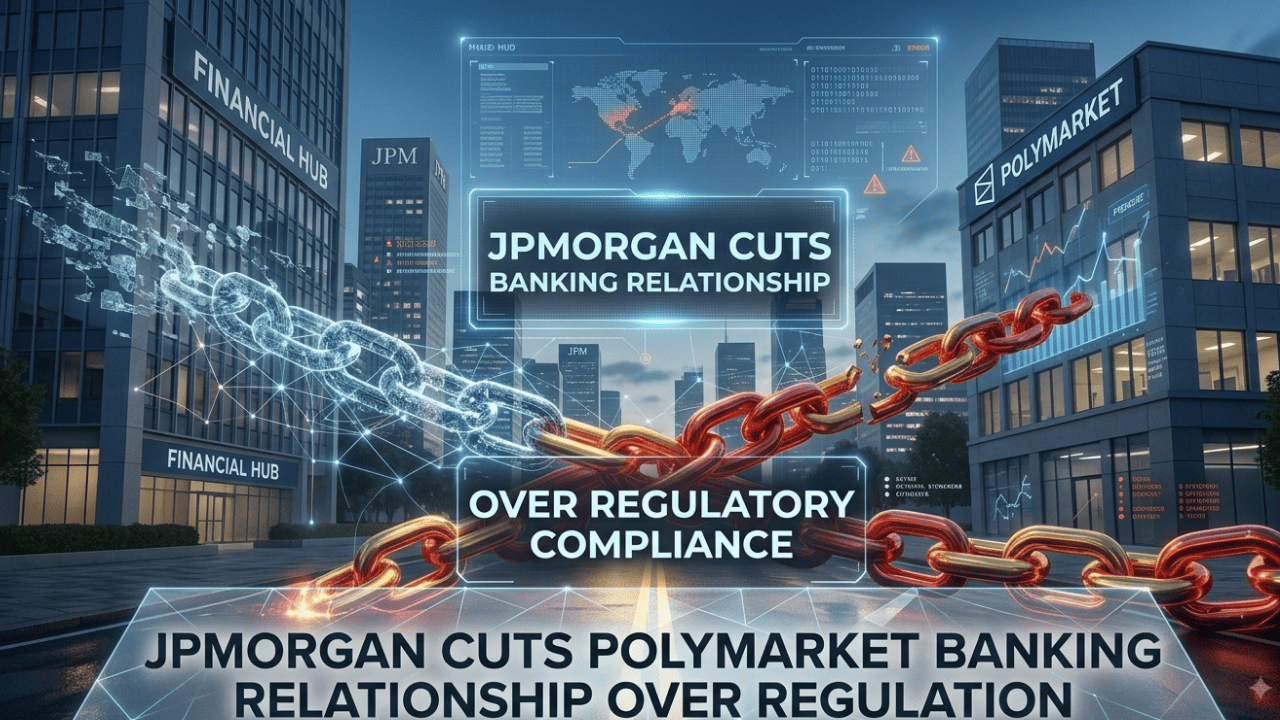
JPMorgan Chase & Co. has officially terminated the **JPMorgan Polymarket relationship** in late 2025, according to a report from the Financial Times. The decision to shutter the accounts of the decentralized prediction market comes amid escalating regulatory concerns regarding the platform’s operations within the United States.
Key Points:
- 2025 marked the conclusion of banking services for the prediction platform.
- Financial Times reported the move followed internal compliance reviews.
- Polymarket faces continued scrutiny from federal commodities regulators.
The dissolution of the banking partnership highlights a growing divide between traditional financial institutions and high-volume decentralized finance (DeFi) platforms. According to the Financial Times, the bank’s decision was not triggered by a single event but was the result of a broader reassessment of the legal and reputational risks associated with prediction markets. Polymarket, which gained significant global attention for its high-volume betting during the 2024 U.S. elections, has operated under a cloud of regulatory ambiguity regarding its accessibility to American residents.
The move by JPMorgan signals a tightening of the “de-banking” trend that has affected various entities in the digital asset space. While the platform utilizes blockchain technology to settle bets, it still requires traditional banking infrastructure to manage corporate treasury and operational expenses. The termination of these services forces the platform to seek alternative financial partners, often at a time when major U.S. banks are increasingly cautious of the Commodity Futures Trading Commission (CFTC) and its stance on event-based derivatives.
JPMorgan Polymarket Relationship Ends

The core of the issue stems from the legal classification of Polymarket’s services. In late 2025, the bank concluded that the platform’s model—which allows users to trade on the outcome of real-world events—carried too much risk of violating the Commodity Exchange Act. Sources familiar with the bank’s internal compliance protocols noted that the shift in policy reflects a wider institutional pivot away from clients who lack clear, federal-level licensure for derivatives trading.
Historically, Polymarket has already faced friction with U.S. authorities. In 2022, the company paid a $1.4 million fine to the CFTC for offering illegal off-exchange event-based binary options. While the platform subsequently agreed to block U.S. users, regulators have expressed skepticism regarding the efficacy of its geofencing measures. The bank’s decision to exit the **JPMorgan Polymarket relationship** suggests that internal risk models no longer view the platform’s mitigation strategies as sufficient to satisfy federal anti-money laundering (AML) and know-your-customer (KYC) standards.
Banking Sector Compliance Shifts

This incident is part of a broader pattern of “de-risking” within the global banking sector. As federal agencies increase their oversight of the crypto-adjacent economy, major institutions like JPMorgan are under pressure to distance themselves from entities that provide tools for speculative trading. The termination of the **JPMorgan Polymarket relationship** echoes previous instances where major banks severed ties with crypto exchanges and offshore trading desks to avoid potential “guilt by association” in federal investigations.
Market analysts suggest that this trend could drive more crypto-native firms toward regional banks or non-U.S. financial institutions. However, the loss of a Tier-1 banking partner like JPMorgan often complicates a firm’s ability to secure lines of credit or process large-scale institutional transfers. For Polymarket, which saw multi-billion dollar trading volumes throughout the previous year, the loss of a major clearing partner represents a significant hurdle for its corporate scalability and long-term stability.
The broader prediction market industry is now closely watching how other financial institutions respond to this development. If other major banks follow JPMorgan’s lead, the industry could face a liquidity crunch or be forced into more opaque financial arrangements. This development occurs as the CFTC continues to debate new rules that could either clarify the status of event contracts or ban them entirely for retail participants.
Looking ahead, the future of the **JPMorgan Polymarket relationship** serves as a cautionary tale for the DeFi sector. As decentralized platforms grow to a size where they require traditional financial services, they must reconcile their permissionless nature with the strict compliance mandates of the global banking system. The outcome of Polymarket’s search for new banking partners will likely serve as a barometer for the viability of decentralized prediction markets in a regulated environment.