
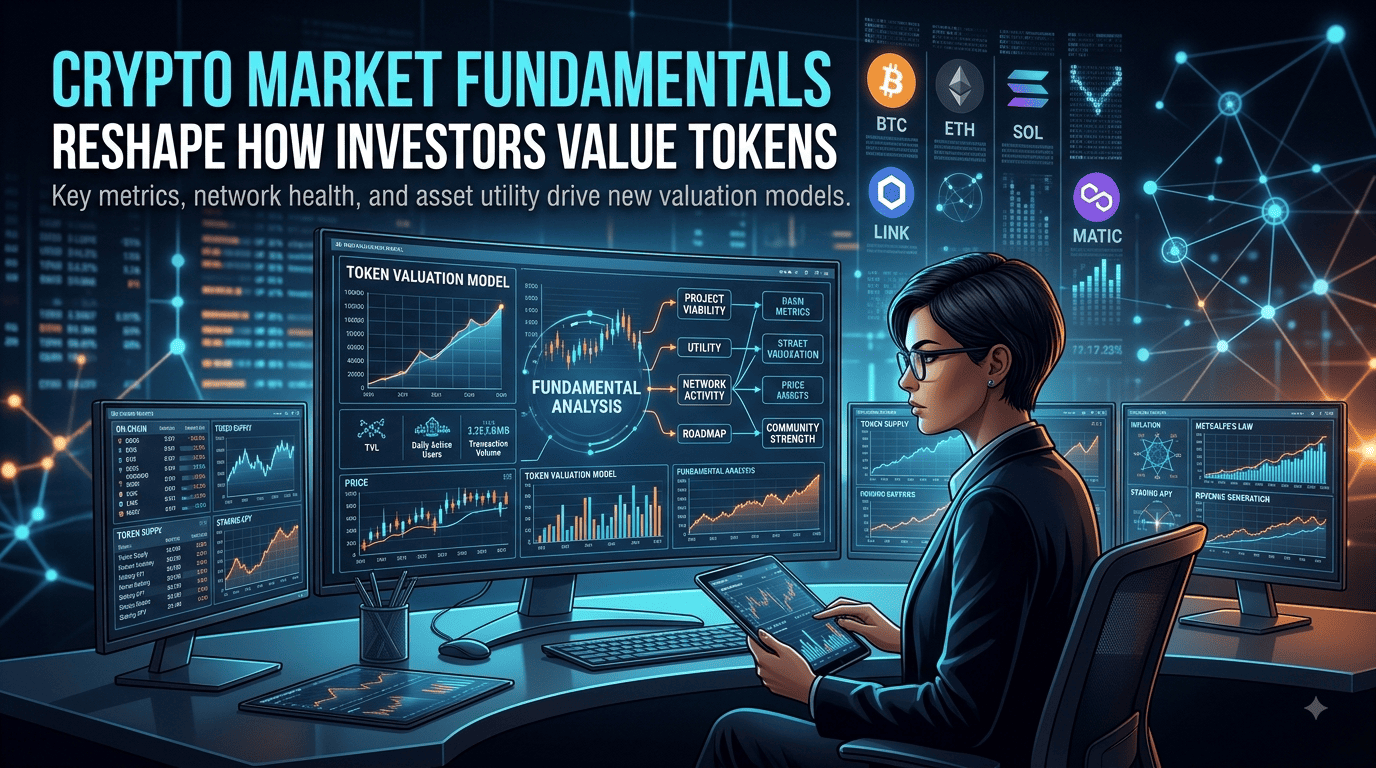
Crypto market fundamentals are becoming the primary driver for investment decisions as market participants move away from a strict reliance on market-cap rankings. Industry executives note that the focus has shifted toward network usage, economic sustainability, and value capture mechanisms during the current market cycle.
Key Points:
- 3 primary metrics—usage, economics, and value capture—now define institutional asset evaluation.
- On-chain activity data frequently contradicts traditional market-cap rankings.
- Protocol revenue generation is a critical factor for long-term token survival.
The transition marks a significant evolution in the digital asset sector as it moves toward maturity. Historically, retail and institutional investors relied on market-cap rankings as a primary filter for investment decisions, often overlooking the underlying health of the protocol. However, a growing number of analysts argue that market-cap is a lagging indicator that can be easily manipulated by low circulating supplies and high fully diluted valuations (FDV).
According to reports from industry leaders, the focus is shifting toward “real-world” utility and on-chain efficiency. This change is driven by a desire to avoid “ghost chains”—networks with multi-billion dollar valuations but negligible daily active users or transaction volume. By prioritizing crypto market fundamentals, investors are seeking assets that demonstrate a clear correlation between network growth and token value.
Quantifying Protocol Value Capture

One of the most significant shifts in the current landscape is the emphasis on value capture. In previous cycles, a token could experience massive price appreciation based on narrative alone. Today, sophisticated investors demand to see how a protocol’s success translates into benefits for token holders. This is often measured through “buy-back and burn” mechanisms or direct staking rewards fueled by protocol fees. Data from CoinDesk suggests that projects with transparent revenue streams are outperforming those that rely solely on speculative interest.
This “fundamentalist” approach is particularly evident in the Decentralized Finance (DeFi) sector. Protocols such as Uniswap and Aave are increasingly judged by their price-to-earnings (P/E) ratios, a metric traditionally reserved for equity markets. When investors analyze crypto market fundamentals, they look for protocols that can sustain operations without excessive token emissions, which can dilute existing holders and suppress long-term price action.
Revenue Over Market Rank

The reliance on market-cap rankings has faced criticism due to the prevalence of “vc-backed” tokens with high FDVs. These assets often launch with only a small percentage of their total supply in circulation, creating an artificially high market-cap rank. As these tokens enter their unlock periods, the sudden increase in supply often leads to significant price devaluations. Investors are now looking past the surface-level rank to examine the tokenomics and unlock schedules that dictate future supply shocks.
On-chain metrics, such as Total Value Locked (TVL), daily active addresses, and transaction fees paid, provide a more accurate picture of a network’s health. For instance, a Layer 2 solution might rank lower in market-cap than a legacy Layer 1 blockchain, but if the Layer 2 processes ten times the transaction volume and generates more revenue, it may be considered a superior investment under the lens of crypto market fundamentals. This shift encourages developers to build applications that people actually use, rather than focusing on marketing to boost market-cap rankings.
Assessing On-Chain Economics
As the industry moves away from speculative hype, the role of on-chain data providers has become more prominent. Tools that track “real yield” and protocol expenses allow investors to differentiate between organic growth and subsidized activity. The “usage” component of crypto market fundamentals ensures that the capital flowing into an ecosystem is being utilized for productive purposes, such as lending, trading, or securing the network, rather than sitting idle in speculative wallets.
Furthermore, the macro environment has forced a more disciplined approach to asset selection. With higher interest rates globally, the opportunity cost of holding non-productive assets has risen. Digital assets must now compete with traditional yield-bearing instruments, making the economic throughput of a blockchain more important than its position on a leaderboard. This maturity is expected to lead to a more stable market where prices are anchored by utility rather than temporary trends.
The move toward evaluating crypto market fundamentals suggests that the market is entering a phase of rationalization. While market-cap rankings will remain a useful tool for a quick overview of the landscape, they are no longer the definitive guide for capital allocation. Future market cycles will likely see a widening performance gap between protocols with robust economic engines and those that lack sustainable value capture.