
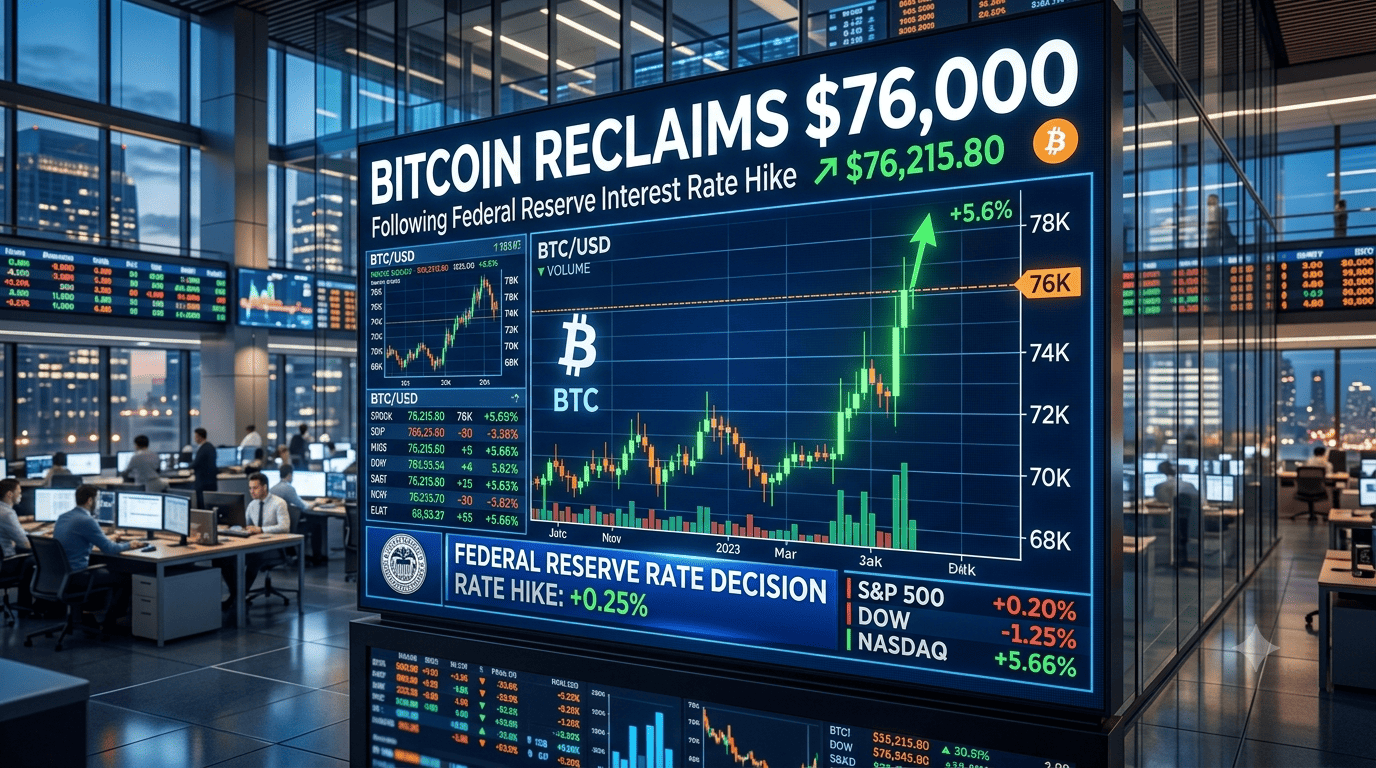
The Federal Reserve announced a unanimous decision to increase the target interest rate range by 25 basis points on September 16, 2026. This move, which brings the benchmark rate to between 3.75% and 4.00%, comes at a time of shifting dynamics within the digital asset market. Despite the tightening of monetary policy, Bitcoin demonstrated resilience by reclaiming the $76,000 level shortly after the announcement, recovering from an intraday low of $75,064.82.
The market reaction highlights a complex interplay between traditional macroeconomic indicators and cryptocurrency-specific metrics. While the Federal Reserve continues its efforts to manage the economy, Bitcoin’s price action suggests a decoupling from the immediate bearish sentiment that affected traditional equities following the news. However, underlying data regarding exchange-traded funds (ETFs) and corporate accumulation indicate that institutional appetite may be entering a period of consolidation.
- The Federal Reserve raised interest rates by 25 basis points to a range of 3.75%–4.00% in a 12-0 vote.
- Bitcoin recovered to $76,000 after dipping to $75,064.82, even as US spot ETFs saw $450.4 million in net outflows.
- Corporate treasury accumulation has slowed significantly, with only 5,900 BTC added over the last three months.
- Technical data from Glassnode identifies $76,700 as a critical “True Market Mean” for active investors.
Federal Reserve Tightens Policy Amid Economic Shifts
The Federal Open Market Committee (FOMC), led by Chair Kevin Warsh, reached a consensus to raise rates for the latest cycle. The 12-0 vote reflects a unified stance among policymakers regarding the necessity of maintaining a restrictive environment. This decision follows a period where core annual inflation reached a five-year low on September 11, 2026, suggesting that while inflation is cooling, the central bank remains cautious about premature easing.
The outlook from the Fed remains hawkish. According to recent projections, 16 out of 18 policymakers anticipate at least one additional rate hike before the end of the year. This sentiment weighed heavily on traditional markets; the S&P 500 and the Dow Jones Industrial Average saw declines of 0.7% and 1.2%, respectively, immediately following the announcement. Simultaneously, the 2-year Treasury yield climbed to 4.734%, reflecting expectations of sustained higher borrowing costs.
Historically, Bitcoin has exhibited volatility approximately four times the magnitude of the S&P 500 on days featuring major interest rate decisions. While the initial dip to $75,064.82 aligned with this trend, the subsequent recovery to $76,000 suggests that market participants may have already priced in much of the Fed’s current trajectory. Analysts such as Fabian Dori of Sygnum Bank and Markus Levin of XYO have noted that the market is currently balancing macroeconomic pressures against internal crypto-market fundamentals.
Institutional Outflows and Realized Cap Trends
Despite the price recovery, institutional activity through regulated channels showed signs of cooling. On September 15, 2026, US spot Bitcoin ETFs, including major products like BlackRock’s IBIT and Fidelity’s FBTC, recorded net outflows totaling $450.4 million. This significant withdrawal of capital suggests a cautious approach by institutional investors ahead of the Fed’s decision.
Furthermore, the Realized Cap—a metric that measures the total value of all coins at the price they last moved—recorded its first negative daily reading after a 27-day streak of growth. This shift indicates that the net capital inflow into the Bitcoin network has paused, at least temporarily. Matt Mena of 21Shares and Lewis Huang of Bitget have observed that such pauses often occur when the market reaches a psychological or technical crossroads.
The stablecoin sector also reflects this period of stagnation. The total supply of stablecoins remains flat at approximately $301 billion. This figure is roughly 4% below the peak reached in April, suggesting that there is currently less “dry powder” available on the sidelines to drive immediate upward momentum. Martin Lee of DWF Labs points out that without an expansion in stablecoin supply, sustained rallies often lack the necessary liquidity to break through major resistance levels.
The Slowdown in Corporate Treasury Accumulation
One of the most notable shifts in the current market cycle is the dramatic slowdown in corporate treasury purchases. Over the past three months, corporations have added only 5,900 BTC to their holdings. This is a stark contrast to the activity seen in July 2025, when corporate buying reached a staggering 89,000 BTC in a single month.
This deceleration in buying may be attributed to the current cost basis of these corporate holders. Data suggests that the average cost basis for corporate treasuries currently sits at $80,500. As Bitcoin trades below this level, the $80,500 mark is acting as a significant technical resistance level. Until the price can convincingly clear this threshold, corporate entities may remain hesitant to increase their exposure, focusing instead on managing their existing positions.
Technical indicators provided by Glassnode further clarify the current valuation landscape. The “True Market Mean,” which represents the average price paid by active investors, is currently identified at $76,700. With Bitcoin trading near this level, the market is essentially at a break-even point for the average active participant. This often leads to increased volatility as buyers and sellers fight for control near this equilibrium point.
What Happens Next
The immediate future for Bitcoin appears tied to its ability to maintain support above the $71,300 level while attempting to challenge the $76,700 True Market Mean. If the price can stabilize above these levels, it may provide the foundation for a test of the $80,500 corporate resistance. However, the persistent outflows from spot ETFs and the flat stablecoin supply suggest that a catalyst may be needed to spark renewed institutional interest.
Market participants will be closely watching the Federal Reserve’s next move, particularly given that most policymakers expect another rate hike this year. Any shift in inflation data or employment figures could alter the Fed’s path, which in turn would likely impact Bitcoin’s volatility. For now, the market remains in a state of watchful waiting, balancing the reality of higher interest rates against the long-term thesis of digital asset adoption.
The coming weeks will likely reveal whether the current price recovery is a temporary bounce or the start of a more sustained trend. With the Realized Cap showing its first negative reading in nearly a month, the focus will be on whether capital begins to flow back into the ecosystem or if the current consolidation phase extends into the final quarter of the year.