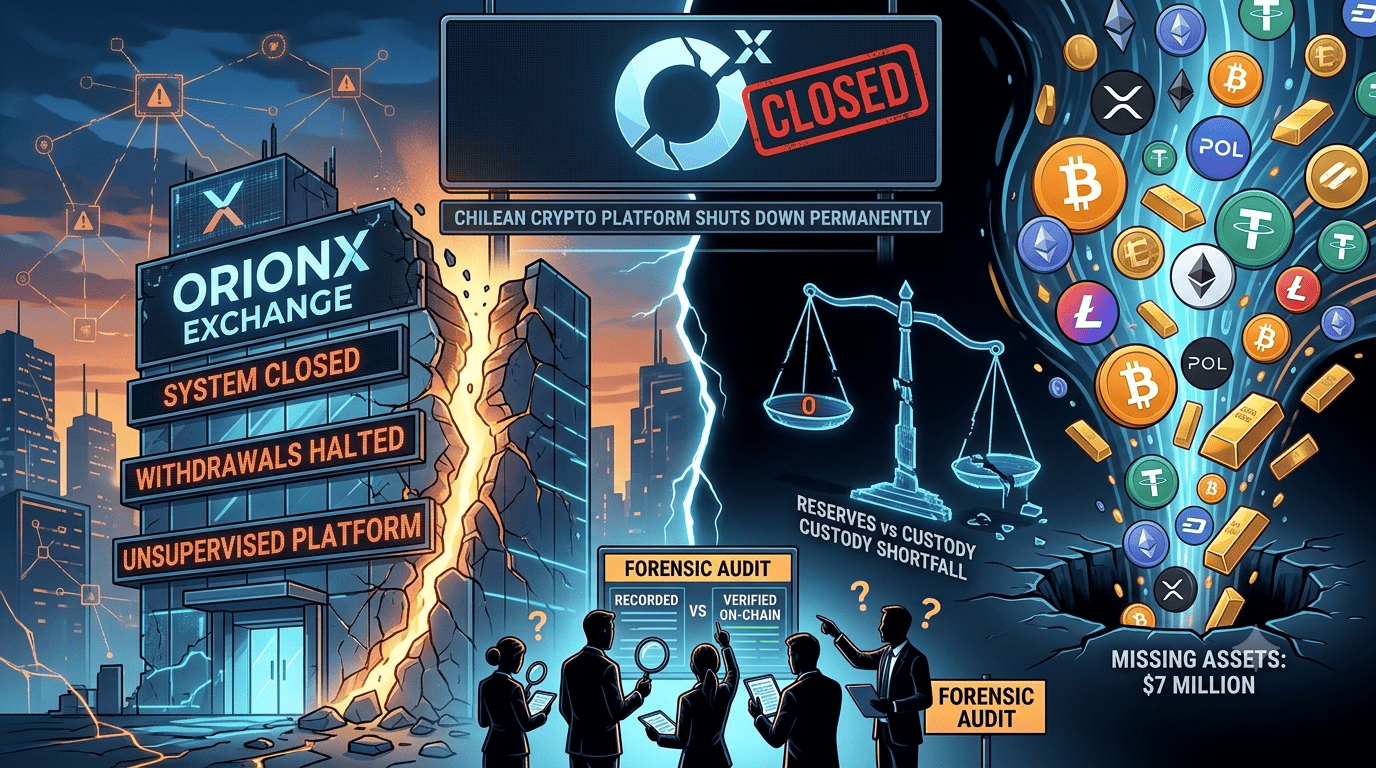
The Chilean cryptocurrency landscape is facing a significant shift as Orionx, a well-known digital asset exchange in the region, has announced its permanent closure. This decision follows the discovery of a substantial financial discrepancy involving millions of dollars in customer funds. The exchange has officially frozen all customer withdrawals, citing the need to protect the remaining assets while it navigates a complex legal and financial wind-down process.
The situation escalated after a forensic audit commissioned by the platform revealed that more than $7 million in customer assets had been transferred to various wallets outside the exchange’s direct control. This discovery has prompted immediate legal action and a structured plan to terminate operations, leaving many users in a state of uncertainty regarding the recovery of their holdings.
Key Developments in the Orionx Closure:
- A forensic audit identified over $7 million in unauthorized transfers to external wallets.
- The exchange has initiated a five-stage closure process, currently focusing on account reconciliation.
- Chile’s financial regulator, the CMF, has stated it lacks the legal power to intervene or force repayments.
- Criminal complaints have been filed against former executives suspected of involvement in the missing funds.
Forensic Audit Reveals Unauthorized Transfers
The catalyst for the current crisis at Orionx was the completion of a detailed forensic audit. This investigation was launched to scrutinize the exchange’s internal ledgers and wallet movements. The findings were stark, indicating that a sum exceeding $7 million in customer-owned assets had been moved to wallets that the exchange no longer manages. These transfers appear to have occurred without the necessary authorization or oversight, leading to a significant hole in the company’s balance sheet.
In response to these findings, Orionx took formal legal steps on September 2 by filing a criminal complaint. The legal action targets former executives of the company, alleging their involvement in the disappearance of the assets. By pursuing this route, the exchange aims to hold those responsible accountable, though the timeline for any potential recovery of the funds remains unclear. The move to freeze withdrawals was described by the exchange as a necessary measure to ensure that a few “first-mover” customers do not deplete the remaining reserves at the expense of the broader user base.
The exchange has emphasized that the freeze is a temporary but essential component of their restitution strategy. Without this pause, the platform argued that the remaining liquidity could be unfairly distributed, leaving late-arriving claimants with no recourse. The forensic audit serves as the primary evidence for the criminal proceedings, and its results have fundamentally altered the exchange’s ability to continue as a going concern.
Regulatory Rejection and the Fintech Act
The downfall of Orionx is also deeply tied to its relationship with Chile’s financial regulatory body, the Comisión para el Mercado Financiero (CMF). On June 19, the CMF officially rejected Orionx’s application for registration and authorization. This rejection was a critical blow, as it effectively ended a transitional period that had allowed the exchange to operate while seeking formal approval under the country’s evolving regulatory framework.
According to reports, the CMF’s decision to deny the application was rooted in the exchange’s failure to meet specific requirements set forth by Chile’s Fintech Act. A primary issue was the inability of Orionx to secure the necessary collateral required for approval. This collateral is intended to serve as a safety net for consumers, and without it, the regulator determined that the exchange did not meet the safety standards necessary for a formal license.
Perhaps most concerning for affected users is the CMF’s current stance on the wind-down. The regulator has publicly stated that it lacks the legal authority to oversee the closure process or to compel Orionx to repay its customers. Because the exchange failed to achieve full registration, it falls outside the direct supervisory umbrella that would allow the CMF to intervene in the liquidation. This leaves the resolution of the $7 million discrepancy largely in the hands of the Chilean judicial system and the exchange’s internal management.
The Five-Stage Wind-Down Strategy
To manage the cessation of its services, Orionx has outlined a five-stage closure plan. The exchange is currently in the first stage, which involves a comprehensive reconciliation of all user accounts. This phase is intended to verify the exact amount of assets owed to each individual user and to compare these figures against the remaining assets held by the platform. The reconciliation process is a prerequisite for any future distribution of funds, as it establishes a clear ledger of liabilities.
The subsequent stages of the plan are expected to involve the liquidation of remaining corporate assets and the implementation of a restitution plan. However, the exchange has not yet provided a specific timeline for when users might expect to receive a portion of their holdings. The complexity of the missing $7 million adds a layer of difficulty to this process, as the total pool of available assets is significantly lower than the total user balances.
The exchange’s management has stated that they are working toward a solution that maximizes the return for all affected parties. However, they have also cautioned that the process will be lengthy and subject to the outcomes of the ongoing legal battles. The transition from the first stage of reconciliation to the actual distribution of assets will likely depend on the clarity provided by the forensic audit and the progress of the criminal complaint filed against the former executives.
Strategic Context and Investor Impact
The collapse of Orionx is particularly notable given the high-profile backing the exchange received in recent years. In 2023, the major cryptocurrency exchange Bitfinex made an investment in Orionx, signaling confidence in its potential to capture the Latin American market. This was followed by a significant investment from Tether in June 2025, which was intended to support the exchange’s expansion across the region. These investments were seen as a validation of Orionx’s business model and its role in the growing Chilean crypto ecosystem.
The involvement of such major industry players highlights the unexpected nature of the exchange’s internal failures. The investments were predicated on the assumption that Orionx would successfully navigate the regulatory requirements of the Fintech Act and establish itself as a compliant, secure gateway for digital assets in South America. The subsequent discovery of missing funds and the rejection by the CMF represent a sharp reversal of the growth trajectory that these investors had supported.
The situation serves as a reminder of the risks inherent in the exchange sector, even for platforms that attract institutional-grade investment. The failure to secure the required collateral for the CMF registration suggests that internal financial management may have been struggling long before the forensic audit revealed the $7 million shortfall. For the broader Latin American market, the Orionx closure may lead to increased scrutiny of other regional exchanges and a more cautious approach from international investors.
What Happens Next
As Orionx moves forward with its five-stage closure, the primary focus remains on the completion of the account reconciliation phase. This will provide the first clear picture of the total deficit and how the remaining assets might be divided among the user base. The exchange is expected to provide updates as it transitions between stages, though the withdrawal freeze remains in effect indefinitely.
The legal proceedings against the former executives will also be a critical factor to watch. If the criminal complaint leads to the recovery of any of the $7 million in missing assets, it could significantly alter the restitution plan for customers. However, such legal battles are often protracted, and there is no guarantee that the funds can be successfully clawed back from external wallets.
Finally, the role of the CMF may continue to be a point of contention. While the regulator currently maintains it has no power to intervene, the scale of the loss may prompt discussions regarding future legislative changes to the Fintech Act to better protect consumers in similar scenarios. For now, Orionx users are left to wait for the results of the internal reconciliation and the slow progress of the Chilean courts.