
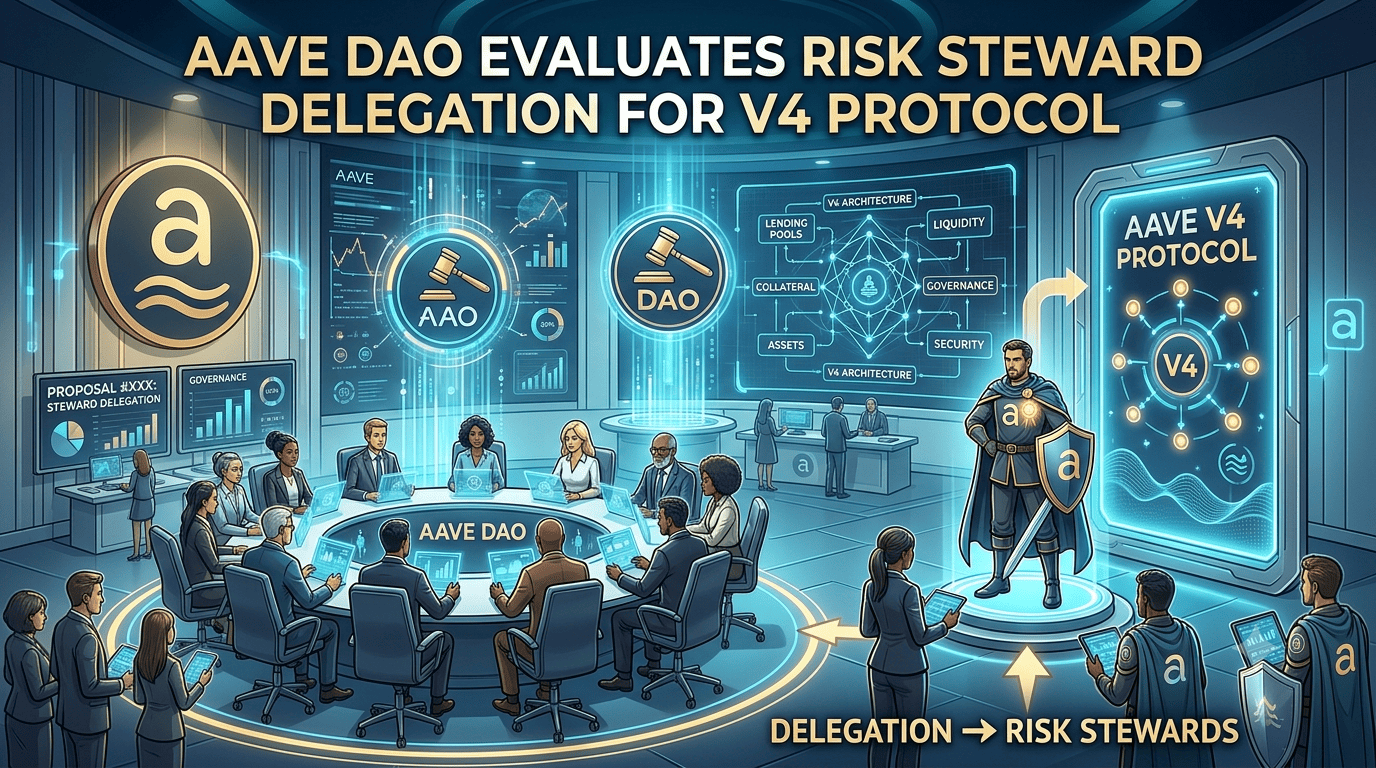
The Aave DAO is currently engaged in a pivotal voting process regarding the governance and operational framework of its upcoming V4 protocol. The proposal under consideration focuses on the delegation of limited risk controls to specialized entities known as Risk Stewards. This move is intended to streamline the management of the protocol on both the Ethereum and Avalanche networks, marking a significant shift in how the decentralized lending platform handles routine adjustments and emergency responses.
According to the proposal documentation, the introduction of Risk Stewards represents an effort to modernize the protocol’s administrative capabilities. By delegating specific, constrained powers to approved operators, the DAO aims to reduce the reliance on full governance votes for every minor parameter update. This evolution is part of a broader strategy to enhance the agility of the protocol while maintaining the rigorous security standards expected by its global user base.
Key Developments in the Aave V4 Proposal
- The delegation of “Hub and Spoke” risk-management and emergency roles to Risk Stewards on Ethereum and Avalanche.
- The implementation of “one-way” emergency controls that allow for asset freezing or deactivation without the power to reverse those actions.
- The introduction of mandatory cooldown periods ranging from 36 to 72 hours for routine parameter adjustments, such as interest rates and collateral factors.
- A multi-stage activation process that requires both a successful Snapshot vote and execution by the V4 Security Council.
The Mechanics of Risk Stewards in Aave V4
Risk Stewards are designed as automated or semi-automated tools that function within strictly defined boundaries set by the Aave DAO. Under the current proposal, these stewards would be granted specific roles within a “Hub and Spoke” architecture. This model allows for localized management of risk parameters on different blockchains while maintaining a centralized point of oversight. The primary objective is to allow the protocol to adapt to market conditions more rapidly than the traditional governance cycle typically permits.
The roles assigned to these stewards are categorized to ensure that no single entity has excessive control over the protocol. By splitting configurator controls into granular domains—such as listing, risk-management, and emergency roles—the Aave V4 architecture seeks to prevent the concentration of power. This modular approach to permissions is intended to provide a more resilient framework for managing the complexities of a multi-chain lending environment.
It is important to note that the current iteration of the Risk Steward software is not yet fully operational regarding emergency selectors. The proposal seeks to grant these roles now so that future versions of the software can respond to crises immediately upon deployment. This proactive delegation ensures that when the technology is finalized, the protocol will not be delayed by a new round of governance votes during a time-sensitive emergency.
Emergency Protocols and One-Way Safety Measures
One of the most critical aspects of the Risk Steward proposal is the definition of emergency roles. To protect the protocol from potential abuse or errors, these roles are strictly limited to “one-way” safety actions. This means that a Risk Steward can deactivate, halt, pause, or freeze assets and reserves if a threat is detected, but they lack the authority to undo these actions. The power to unpause or reactivate a market remains exclusively with the DAO or higher-level governance bodies.
This design choice is a deliberate safeguard. It ensures that while an emergency response can be executed with no delay, the restoration of normal operations requires a more comprehensive review process. By removing the ability for stewards to reverse their own emergency actions, the protocol mitigates the risk of a compromised steward being used to maliciously manipulate market states. This balance of immediate defense and deliberate recovery is a cornerstone of the V4 security philosophy.
Furthermore, the emergency selectors are intended to function without the standard execution delays that govern routine changes. In a high-volatility scenario or a potential exploit, the ability to freeze a reserve instantly can be the difference between a minor incident and a significant loss of funds. The DAO’s consideration of these roles reflects an ongoing dialogue within the DeFi space about the necessity of rapid-response mechanisms in decentralized systems.
Balancing Efficiency with Governance Oversight
While emergency actions are designed for speed, routine updates to the protocol’s risk parameters are subject to significant constraints. The proposal outlines specific cooldown periods and caps to ensure that adjustments to interest rates, collateral factors, and other vital settings are made transparently and predictably. Depending on the nature of the change, minimum cooldowns of 36, 48, or 72 hours are required before a parameter update can take effect.
These cooldowns serve as a buffer, allowing the community and third-party observers to monitor the actions of the Risk Stewards. If a proposed change is deemed inappropriate or risky, the DAO has a window of time to intervene. Additionally, the proposal includes caps on how far a parameter can be moved in a single update. This prevents sudden, drastic shifts in the protocol’s economic environment, providing a more stable experience for borrowers and lenders alike.
The integration of these constraints highlights the DAO’s attempt to solve the “governance bottleneck.” In previous versions of the protocol, even minor adjustments required a full proposal, a waiting period, and a community-wide vote. By delegating these tasks to Risk Stewards within a pre-approved range, the DAO can focus its attention on high-level strategic decisions while the stewards handle the day-to-day maintenance of the protocol’s health.
Context and the V4 Permission Redesign
The current proposal does not exist in isolation; it is a component of a comprehensive redesign of the Aave V4 permissioning system. This redesign splits the protocol’s configurator controls into five distinct categories: flag-control, listing, emergency, risk-management, and residual domain-admin roles. This granularity is intended to provide a more sophisticated level of control than was possible in earlier versions of the Aave protocol.
By categorizing permissions in this way, Aave Labs—the developers behind the protocol—aim to create a system where the DAO can delegate specific tasks to the most qualified entities without giving up ultimate control. For example, a specialized risk-management firm could be granted the risk-management role, while a security-focused group could hold the emergency role. This specialization is expected to lead to more informed and efficient protocol management.
The initiative also addresses the growing complexity of managing a protocol across multiple chains. With Aave V4 expanding its footprint on Ethereum and Avalanche, the need for a scalable governance solution has become more pressing. The Risk Steward model provides a template for how the DAO might manage its presence on additional networks in the future, ensuring consistency in risk management across the entire Aave ecosystem.
What Happens Next
The immediate future of the Risk Steward implementation depends on the outcome of the ongoing Snapshot vote, which is scheduled to conclude between September 3 and September 6, 2026. If the community approves the proposal, the transition will not be instantaneous. The V4 Security Council must then execute the corresponding payloads to officially grant the roles to the designated contracts.
Security remains a primary focus as the protocol moves toward these changes. The Risk Steward contracts are currently undergoing a rigorous audit by Certora, a prominent blockchain security firm. This audit is reportedly nearing finalization, and its results will be a critical factor in the final deployment of the system. The DAO has signaled that no roles will be fully operational until the security community is satisfied with the integrity of the code.
As the Aave V4 protocol continues to take shape, the success of the Risk Steward model will likely be watched closely by other decentralized finance projects. The attempt to balance automated efficiency with decentralized oversight represents a significant experiment in the evolution of DAO governance. Whether this model can successfully navigate the challenges of market volatility and security threats remains to be seen, but the current proposal marks a definitive step toward a more automated and modular future for Aave.